A box sample that arrives empty.
You quote postage from it. The box you ship is not the same size, and the carrier bills the one you ship. That's how a 5.2 lb gift box goes out on UPS or FedEx billed as 12.1 lb.

Free guide for brands that sell a gift set, a club box, a sampler or a bundle
The Kit Playbook shows you which cheap parts to check in your own kit before you print 1,000 cartons.
Inside the guide:
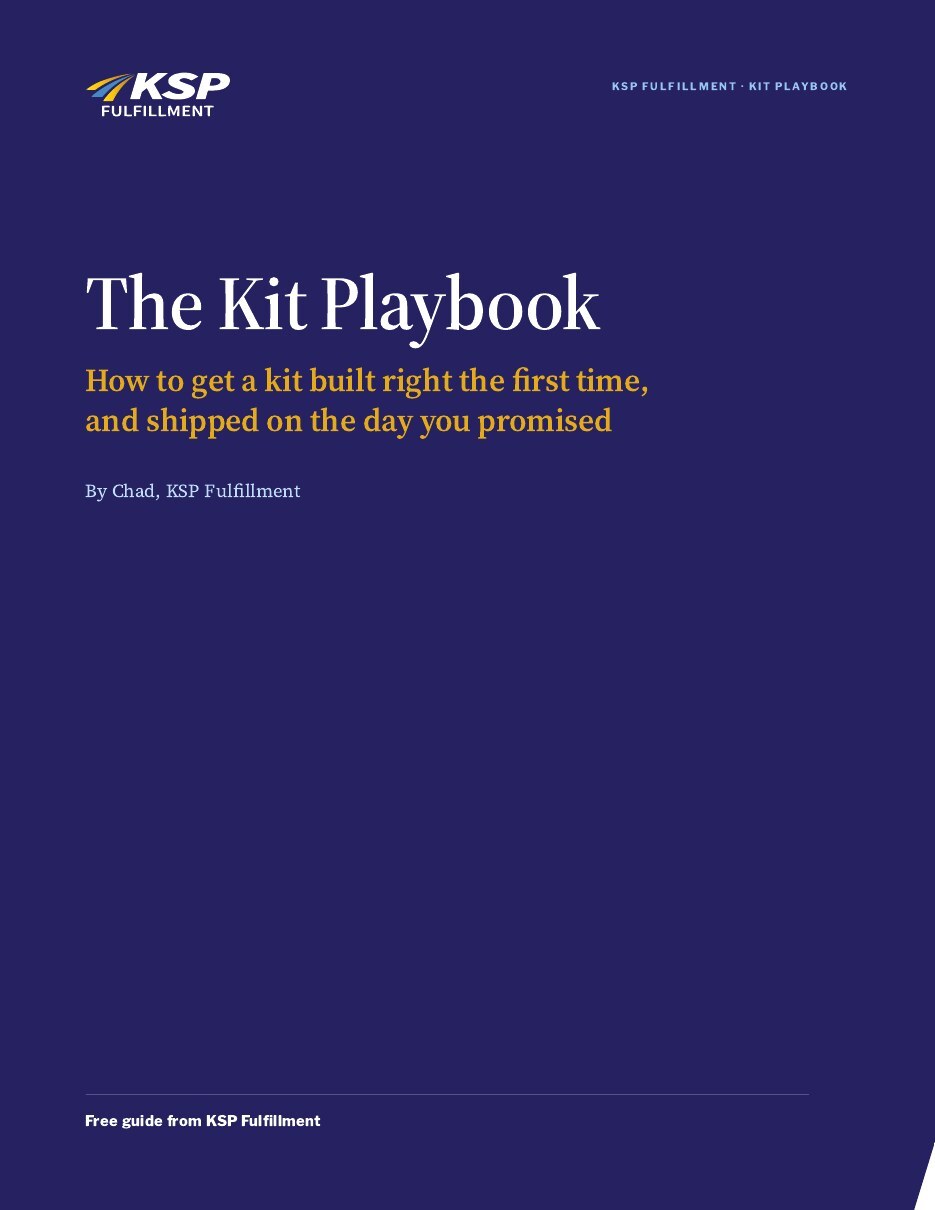
Eleven short chapters in a free PDF, each one ending with a few things to do.
Free. Unsubscribe anytime. Privacy policy
Written by KSP Fulfillment. We've built 20.9 million kits on our 50,000-square-foot kitting floor in Brooklyn Park, Minnesota.
The candy. We built a gift kit for a promotional products company. 1,700 kits, going to 1,700 different addresses. Each one held a puzzle cube, a small game console, two bags of candy and crinkle paper in a white box.
Partway through, the build stopped with about 400 kits to go. The puzzle cubes were on the shelf. The game consoles were on the shelf. The boxes were stacked and ready. The candy had run out, and those 400 kits sat until about 800 more pieces came in.
The sheet of labels. A seller on Amazon had it worse. The prep company grabbed the wrong label sheet and put one product's labels on another. 400 units got checked into Amazon under the wrong listing. Support tickets went nowhere. The seller couldn't pull the stock back out, and watched competitors take the buy box while the real listing showed out of stock. It cost three weeks of sales during Q4.
The poly bag. We built 50,000 of one welcome kit on a rush. The brand's poly bag was too narrow for the folded tote that went inside it, so every kit needed one extra fold at the seal. That's one fold, 50,000 times. Our second shift worked out a faster way to load the bag and built 10,350 kits in a single night.
Nobody had a problem with the puzzle cube, the tote or the product under the wrong label. What went wrong each time was the cheapest thing on the table.
Think back to the last kit you launched.
The product took months. The box got a designer, three rounds of samples and a long talk about the finish. The insert card got written the week of the build. The sampler, the sticker and the tissue paper got one line in an email, and nobody wrote down how many you needed or what day they'd land.
Nobody you pay is paid to look at those parts, either. Your printer looks at the box. The bundle app looks at the listing, and your designer looks at the unboxing. The cheap parts meet each other for the first time on a packing bench, on build day, with the truck already booked.
And a kit is the one thing you sell where every part has to show up the same day, fit in the same box and say the right thing to the customer. So when the sampler is two weeks late, the whole gift set is two weeks late, and it doesn't help that the boxes have been ready since October.
You quote postage from it. The box you ship is not the same size, and the carrier bills the one you ship. That's how a 5.2 lb gift box goes out on UPS or FedEx billed as 12.1 lb.
One seller's custom box, with a couple of promo inserts in it, came to about 15 oz. If a customer buys two, it goes over a pound. When your store's shipping rates assume one item, the second one ships on you.
Amazon's own help page prints one ten-word line as an example of a card that breaks its rules. Read it cold and it sounds polite. Amazon holds your account responsible even when a partner packed the card. Off Amazon, a card that pays for a good review falls under the FTC's reviews rule, and the top penalty is $53,088 per violation.
That's the candy. A kit can't ship until its last part shows up, so the cheap part on the slow truck sets the date for everything else in the box.
The box and the postage are still the two biggest lines on a kit's cost sheet, and the guide prices both. Those two you already watch. The candy and the card you don't.
The good news is on the same line of the parts list.
A card costs cents. It's the only thing in the box that can ask your customer for a second order, a review or a friend's order. When delivered orders were mystery-shopped in 2025, only 36% of brands had put a card or a sample in the box. The other 64% paid the postage and shipped the box with no card and no sample in it.
Meanwhile a magnetic rigid box costs $6 to $12 each, by one packaging maker's own price list. And when a packaging company surveyed shoppers in six European countries, a third of them said they'd pay nothing extra for packaging.
Fixing a cheap part costs a few dollars when you catch it on paper. You write a quantity on one line, buy a wider bag, or print a second card for your Amazon orders. Catch the same thing on build day and you're where those 400 kits were.
It's a free PDF, eleven short chapters, written by the people who build kits all day. It goes through a kit in the order you'll run into it and shows what each part does to your ship date, your postage, your labor and your stock. Here's some of what you'll find:
The Kit Playbook is for the owner, founder or ops lead of a US brand shipping 500 or more orders a month that sells a gift set, a club box, a sampler or a bundle, or is about to. It's just as useful if you build kits on your own tables as it is if a 3PL builds them.
If you're still testing your first product, save it for later. You'll get more from it once you have a kit to check.
It's a free PDF, and nothing in it is held back for a call. We build kits for a living, and each chapter ends with a note on how we do that step. You can do every step in it without us.
Then take chapter 10 to them. Ask the blocking-step question, and ask to see the component list they build your kit from. If they have good answers, you've lost ten minutes.
Most of the guide is about the work that happens before anyone touches a box: the parts list, the card, the box size, the calendar. That work is yours wherever the kit gets built.
Good. Then check it before the next carton order instead of after. Start with the cheapest line on the parts list.
Brands that ship with KSP







KSP is a godsend to our business, and we are grateful beyond words to be entrusting our warehousing and fulfillment to them since April 2021. KSP is efficient and professional in every way: orders are filled correctly, efficiently, quickly, and with top service. They find the best and most cost effective way to ship. …
I'm loving your warehouse solution and wonder why I did not do this years ago. We really appreciate how smooth the transition was and how helpful everyone is with the onboarding. Thank you to all involved!
I had a meeting with a client this morning that reminded me of how much trouble we had in 2022 with delivery. She reminded me that they were rejecting more orders than receiving. … Between you and I, I likely would not be with my company still if I hadn't found KSP.
P.S. Before you open the PDF, pull up the parts list for your best-selling kit and find the cheapest line on it. Ask two things. How many do we have? What day do the next ones land? If nobody can answer in a minute, start with chapter 3.
P.P.S. If any of your kits ship through Amazon, go get the card that's in the box right now and read it against chapter 6.
Veteran-owned, founded in 2012 in Brooklyn Park, Minnesota. 20.9 million kits built. 99.999% order accuracy across 32.1 million orders. Our rep replies within 1 business day.