Custom Kitting & Assembly Services, Built Around Your Spec

KSP is a kitting company and a 3PL under one roof, so your kitting services and order fulfillment stay with one operator. Components arrive from any supplier and are counted against your bill of materials. Each kit is built to the approved spec and checked before the box closes, then held as inventory and shipped nationwide. Orders for finished kits received by 2 PM CST ship the same day.

  • 20.9M+ kits built
  • 50,000 sq. ft. dedicated kitting floor
  • BOM check + photo QC before close
A KSP team member assembling products on the kitting floor
KSP team member building a kit on the kitting floor.

What Are Kitting & Assembly Services?

Kitting and assembly services take individual products, components and packaging and turn them into one finished, sellable unit. The provider receives the parts, builds each kit to a bill of materials, applies labels and packaging, checks the finished unit, then stores it, ships it to customers, or routes it to retailers, Amazon or another warehouse.

A missing insert, a wrong variant, a display that arrives flat: each kit error is found by a customer or a retailer, not by you. KSP began in 2012 as Kitting Solutions Plus. Kitting is the work the building was designed around. Today our kitting fulfillment services run on the same floor as daily order fulfillment, so finished kits go straight to shipping without leaving the building. The acronyms on this page (BOM, FNSKU, PDQ) are in our warehouse acronyms guide.

KSP has built more than 20.9 million kits on a 50,000 sq ft kitting floor and runs at 99.999% order accuracy. The 611-store Target rollout on this page ran on that floor: 8 SKUs, 20 kit configurations and more than 75,000 cartons, built into 611 outbound pallets inside four weeks of the product arriving.

3PL Kitting Services & Assembly Programs, Built to Your Spec

Kitting brings components together; assembly, including light assembly, makes the unit ready to ship. These are starting points, not fixed packages.

Custom Product Kitting

Combine multiple components or SKUs into one finished kit or sellable unit.

  • Multi-component product kits
  • Gift sets and promotional kits
  • Seasonal kits
  • Retail-ready product sets
  • Custom product bundles

Subscription Box Assembly

Build recurring boxes accurately and consistently, even when products, inserts or packaging change from one cycle to the next.

KSP coordinates component receiving, batch assembly, packaging, quality control and fulfillment for recurring programs.

How subscription box kitting works

Display Assembly, Packaging & Co-Packing

Prepare products for retail with assembly and packaging workflows built to your specifications.

  • POP and PDQ displays
  • Shelf-ready packaging
  • Multi-unit packs
  • Promotional displays
  • Retail pack-outs

How retail display programs ship

Amazon FBA Prep & Multi-Pack Bundles

Prepare inventory for Amazon and other marketplaces, or turn individual products into ready-to-sell multi-packs under one unit of sale.

  • FNSKU and product labeling
  • Bundling and multi-packs
  • Poly bags and prep kits
  • Case and pallet preparation

Requirements vary by product and shipment, so the prep workflow is scoped with you.

What changed when Amazon ended FBA prep

In-House vs. Prep Shop vs. One-Site 3PL: Where the Hand-Offs Cost You

Brands reach a 3PL kitting page from one of two places. Either the founder is still building kits on a folding table the week before every launch, or a prep shop builds them and a separate warehouse ships them. Both work at small volume. Both break at the hand-off: every time a kit changes hands, someone counts it, someone pays to move it, and someone finds the shortage after it is too late to fix cheaply.

ModelWho does the work, and where the hand-offs sitWhat each hand-off costs
In-house

Your team builds kits in your space, then ships them or trucks finished kits to a fulfillment warehouse. Hand-offs: supplier → you, you → warehouse.

Founder and staff hours in the build week. Rework when a kit is wrong, found by the customer. A freight leg and a second receiving count if a warehouse ships for you.

Prep shop / co-packer + separate warehouse

A kitting vendor receives components and builds; a different warehouse receives the finished kits and ships. Hand-offs: supplier → prep shop, prep shop → warehouse.

Freight between two buildings. Two receiving counts, two inventory records, a shortage that surfaces at the second dock. Two vendors to call when a kit is short, each pointing at the other.

One-site 3PL (kit, store, ship)

One team receives components, builds to the BOM, checks the kit, and puts it into the inventory daily orders ship from. Hand-off: supplier → KSP.

One receiving count against the BOM. No freight between kit and ship. A short component shows up at the dock before the build is scheduled, and one account manager owns the answer.

The one-site model spends less on freight and lets fewer errors through, since the kit that passes the BOM check is the kit that gets picked. It has a limit worth knowing: KSP ships from one building. A brand that needs inventory placed in several regions at once is better served by a distributed network, and we say so on the first call. For everything else, moving the build next to the ship line removes the hand-off. See a day on KSP's kitting floor for how the two sides share one shift.

Case Study: Kits for 611 Target Stores in Four Weeks

A product launch had to land in 611 Target stores ahead of a set installation schedule: 8 SKUs, 20 kit configurations and more than 75,000 cartons. KSP had four weeks from the day the product arrived. The team cross-docked more than 800 inbound pallets, built every kit and shipped 611 outbound pallets, all from one building.

Target stores delivered
611
Product received to all 611 outbound pallets built
4 weeks
Cartons across 8 SKUs and 20 kit configurations
75,000+
Inbound truckloads, more than 800 pallets cross-docked
20
  1. 01

    Components in, the assembly line never stopped

    KSP coordinated with the import company to cross-dock and transport 20 truckloads of more than 800 pallets to the fulfillment center, and kept all eight SKUs on hand so the assembly team kept moving. When containers sat in customs, KSP arranged hot-shot equipment instead of idling the line.

  2. 02

    20 kit configurations, 611 outbound pallets

    Each outbound pallet averaged about 80 cartons and carried 12 custom placards, three on each side, so the delivery reached the correct department and team at the store. KSP set the stacking and wrapping configuration for LTL transportation and put an instruction manual in every kit.

  3. 03

    About 25,000 overage cartons for store reorders

    Those cartons went to the OEM warehouse to support store-level reorders. Each one was labeled with its part number, PO and quantity, and the pallets were built to routing requirements under 50 inches and delivered across 10 truckloads, with the appointments and schedule changes handled by KSP.

  4. 04

    No added floor and no rental trailers

    The whole program ran on the existing floor. KSP completed the work without securing additional warehouse space or leasing rental trailers.

All 611 stores received their shipments on time, ahead of the installation schedule, with no damage or shortages.

How a Kitting Program Runs at KSP

The four rules buyers ask about before they send a spec: run size, release timing, build method, and what happens when a component is short.

Run size and capacity

Programs range from a one-time promotional build to recurring monthly cycles and high-volume projects, all on a 50,000 sq ft kitting floor. Send the kit count, the configuration and the date, and KSP confirms capacity against them before anything goes on the production schedule.

The 2 PM CST cutoff

Finished kits are inventory. Orders for them received by 2 PM CST ship the same day, and kits completed before the 2 PM CST cutoff release the same day. Ground delivery reaches any U.S. address in 1–3 days, with 2-day delivery nationwide available via overnight service.

Pre-kit or kit-to-order

Pre-kit when variants are few and the quantity is known: components are built into finished-kit SKUs ahead of demand and picked like any other item. A pre-kit that doesn't sell stays in your inventory until it does. Kit to order when variants multiply or the order file changes late: components stay separate and each kit is built as its order releases. Many programs run a hybrid, a pre-kitted core with add-ons picked at pack-out.

How this plays out in subscription box fulfillment

Component receiving and short ships

Every inbound is counted against the kit's bill of materials, and your portal shows on-hand versus required, by component. When a supplier short-ships, your account manager tells you before the build starts, with the count and the number of complete kits the floor can still build. Then we work out the next move with you: hold the run, release the complete kits, or substitute.

How a Build Moves Through KSP

Four stages, one hand-off. Each is scoped against your instructions before production begins.

  1. Send Your Components & Requirements

    Components arrive from your suppliers or your own warehouse. Each receipt is counted against the bill of materials and shown by component in your portal, so a short ship surfaces at the dock, not on the line.

    Before production begins, we align on the kit configuration, quantities, packaging, instructions, labels and final destination.

  2. We Build, Kit or Assemble

    Our team follows your approved project specifications to assemble each unit consistently.

    From a few components to a complex, multi-step pack-out, the workflow is designed around the actual work required.

  3. Verify the Finished Kit

    Every kit variant is checked against its bill of materials before the box is sealed. The quality checkpoints below cover exactly what that check looks at.

  4. Store, Fulfill or Distribute

    Finished kits can remain at KSP for ongoing fulfillment or be distributed to consumers, retailers, Amazon, another warehouse or another destination required by your program.

The QA Process Behind a 99.999% Accuracy Rate

Kit assembly and order fulfillment have different checkpoints. We build verification into both, so your finished product matches the approved configuration and your order follows a controlled picking and packing workflow.

When finished kits move into fulfillment

  1. Identify the Tote

    The associate scans the tote barcode so the system associates the pick with the correct container.

  2. Verify the Item

    The unit barcode is checked against the item expected by the WMS. A mismatch prevents that pick from registering and requires correction before the workflow continues.

  3. Measure the Packed Carton

    Packed cartons pass certified scales and laser dimensioners before labels print. Measured weight and dimensions feed the shipping manifest and multi-carrier rate shopping.

Kitting and Fulfillment Under One Roof

Where the finished kits are going changes the build. Retail shipments carry routing terms and appointment dates; parcel orders carry cutoff times and packaging standards.

So the outbound plan is made while the build is still being scoped: how units are grouped, labeled and packed, and what leaves the dock on which date. Your specification defines the kit; the destination defines everything after it.

All of it happens in one ~225,000 sq ft building in Brooklyn Park with 29 dock doors, a 50,000 sq ft kitting floor, and climate-controlled, FDA-registered storage for the components waiting on a build. Daily orders are picked with the help of 60 Locus robots from the same inventory the finished kits go into. Here is how kitting and fulfillment work together when both run on one floor.
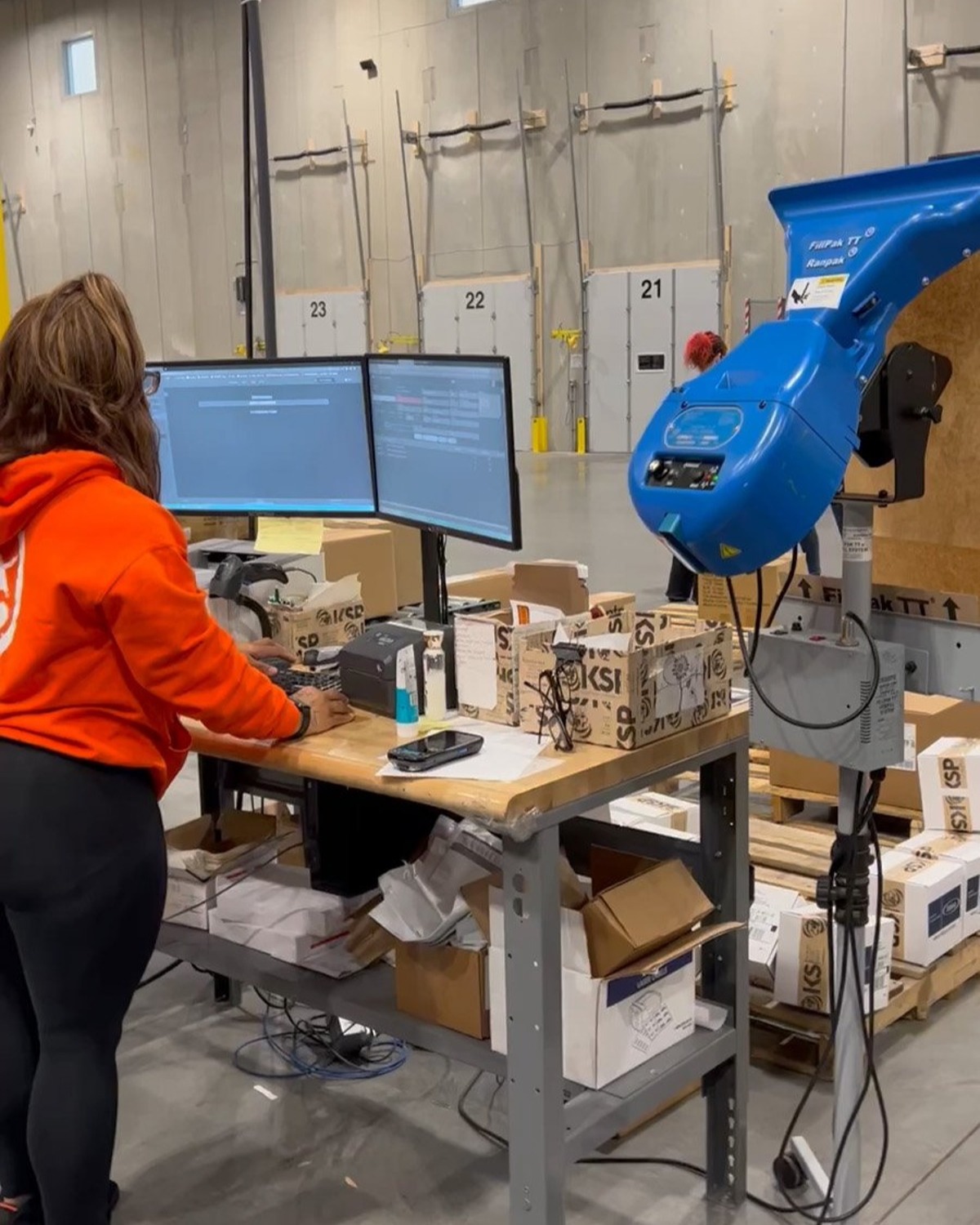
KSP team member working at a fulfillment packing station
KSP team member at a fulfillment packing station. Kit-assembly verification happens earlier, on the kitting floor.

How Much Does Kitting Cost?

KSP quotes every kitting project from your build: components per kit, assembly steps, packaging and materials, run size, and the condition your components arrive in. For a market reference, The Fulfillment Advisor's 2026 survey of 500 U.S. and Canadian warehousing and fulfillment providers reports an average kitting fee of $10.79 per hour. Providers bill kitting by the hour, by the kit or per touch, so put the same build in front of each one and compare the totals.

KSP puts receiving, component storage, packaging materials and outbound shipping on the quote as their own lines next to assembly labor, so the first invoice reads like the proposal.

What Sets the Price of a Kit

Two kitting projects might need very different amounts of labor. Here are 5 factors that can affect your build cost:

Cost driverWhat moves the priceWhat brings it down
Components per kit

Each component is a receipt, a storage location, a pick and a check. Ten items from six suppliers cost more to stage than three from one.

Consolidate suppliers where you can. Ship components kit-ready (counted, labeled, in inner packs).

Assembly steps

Touches per unit: folding, inserting, seating a tray, sealing, applying a sleeve or label. Steps that need a fixture or a second pair of hands cost more than drop-in placement.

Design the pack-out for the line: fewer orientations, inserts that drop rather than tuck, one seal. A sample kit lets us count the touches with you.

Packaging and materials

Custom cartons, tissue, dunnage, branded tape, insert cards. Who supplies them, and whether they arrive flat or pre-formed.

Supply materials with the components. Use carton sizes that nest. Confirm artwork before the run, not during it.

Run size and repeat

Setup happens once per run. A one-time 500-kit promo carries it alone; a monthly program spreads it, and the crew gets faster each cycle.

Batch where demand is known. Lock the spec before the first cycle so the second one does not restart the learning curve.

Inbound condition

Components that arrive uncounted, unlabeled, damaged, or short add a sort and a reconciliation before building can start.

Send a packing list with every inbound. Label cases by component. Tell us about a known short before the truck lands.

Inserts and packaging also change parcel weight, which changes postage on every kit you ship. If your catalog is growing, how kit SKU count changes pick and storage costs covers the second-order effect.

Getting a Kitting Quote

There is no useful one-price-fits-all rate for kitting. The most useful quote starts with the actual build, and the most useful comparison gives every provider the same one.
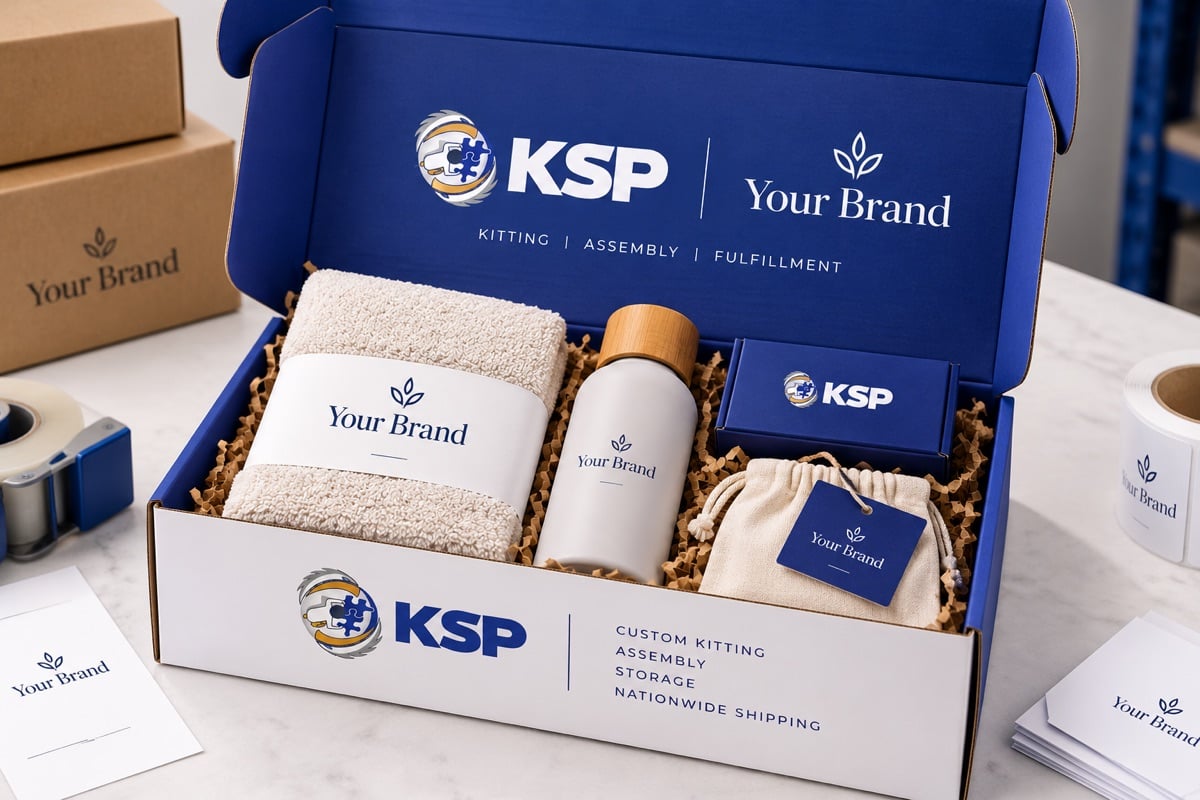
Blue KSP-branded sample kit box with packaged products
Why it is a quote

Every KSP kitting price is a quote, built from the five drivers above. A number quoted before the spec exists is a guess, and a guess is what gets renegotiated after the first run.

What sits inside the rate

Ask every provider which charges are inside the per-kit rate and which are billed per touch: receiving, component storage, inserts, labels, QC, rework, outbound. KSP itemizes each line in the quote so the first invoice reads like the proposal.

Repeat programs and one-time builds

A recurring kit keeps its spec, its fixtures and its trained crew, so the per-kit cost settles after the first cycle. A one-time build carries its setup once. Some new builds carry a setup fee; when one applies, it sits on the quote as its own line, and it can be waived. Both kinds of program are quoted on the same inputs.

Timeline

A standard run typically produces its first finished kits two weeks after the spec is approved and the components are in hand. Run size and the condition components arrive in can move that, so give us the target ship date and we plan backward from it.

What to send for an accurate quote

Photos, a sample kit or a bill of materials make scoping more accurate. To compare providers, give each the same build specifications and ask what receiving, assembly, materials, storage and shipping charges are included.

  • Approximate number of kits
  • Number of components in each kit
  • Packaging requirements
  • Assembly or pack-out instructions
  • Target completion date
  • Where the finished kits need to go

Kitting & Assembly FAQs

The questions ops and procurement teams ask before scoping a kitting program.

What does a kitting company do?

A kitting company receives components from your suppliers, counts them against your bill of materials, builds each kit to spec, checks it, then stores and ships the finished unit. KSP does this on a 50,000 sq ft kitting floor in the same building as order fulfillment, so finished kits ship without a transfer to another warehouse.

How much do kitting and assembly services cost?

The price of a kit is set by components per kit, assembly steps, packaging and materials, run size, and the condition components arrive in. Labor is the largest share. KSP quotes from your spec and itemizes receiving, storage, assembly, materials and outbound separately, so you can compare providers line by line.

What are kitting fees, and how are they charged?

Kitting fees pay for the labor of building your kit, and providers charge them by the hour, by the kit or per touch. The Fulfillment Advisor's 2026 survey of 500 U.S. and Canadian providers reports an average kitting fee of $10.79 per hour. KSP quotes from your build and itemizes each line.

How much does kitting cost per kit?

A kit's price follows its build: components per kit, assembly steps, packaging and materials, and run size. A small sampler takes less labor than a gift set with a printed insert and a sleeve, and the quote shows that. Send the spec, kit count and date, and KSP returns an itemized quote.

Kitting vs. assembly: what is the difference?

Kitting collects finished components into one new sellable unit with its own SKU and leaves the parts alone: a gift set, a sampler, a subscription box. Assembly changes the parts before they ship: folding a display, seating a tray, applying a label. Most programs need both, and assembly is usually where most of the labor goes.

What happens if a supplier short-ships a component?

Every inbound is counted against the kit's bill of materials, so a short shows up at the dock. Your account manager tells you before the build starts, with the count and how many complete kits can still be built. Then we work it out with you: hold the run, release the complete kits, or substitute.

Should I pre-kit or build kits to order?

Pre-kit when you have few variants and a known quantity; the finished kit becomes its own SKU, picks like any item, and stays in your inventory until it sells. Build to order when variants multiply or the order file changes late. Many programs run a hybrid: a pre-kitted core with add-ons picked at pack-out.

How fast do finished kits ship?

Finished kits sit in the same inventory as your daily orders. Orders received by 2 PM CST ship the same day, and ground delivery reaches any U.S. address in 1–3 days. A standard build typically delivers its first finished kits two weeks after the approved spec and components are in hand.

Can KSP receive components from multiple suppliers and connect to my store?

Yes. Components arrive from any number of suppliers, are inventoried separately, and come together at the build. Finished kits are their own SKUs, so orders from Shopify, Amazon, Walmart, WooCommerce, BigCommerce or an EDI retailer flow through the same connection as the rest of your catalog. See KSP integrations.

Let’s talk through your kitting project.

Tell us what goes in each kit, how many you need, and when they need to ship. KSP can handle assembly, storage and outbound shipping together.

Not ready with a full spec? A component list or photos of a current kit will do.

Tell us about your build

Rough numbers are fine. A KSP project specialist will review your request.