
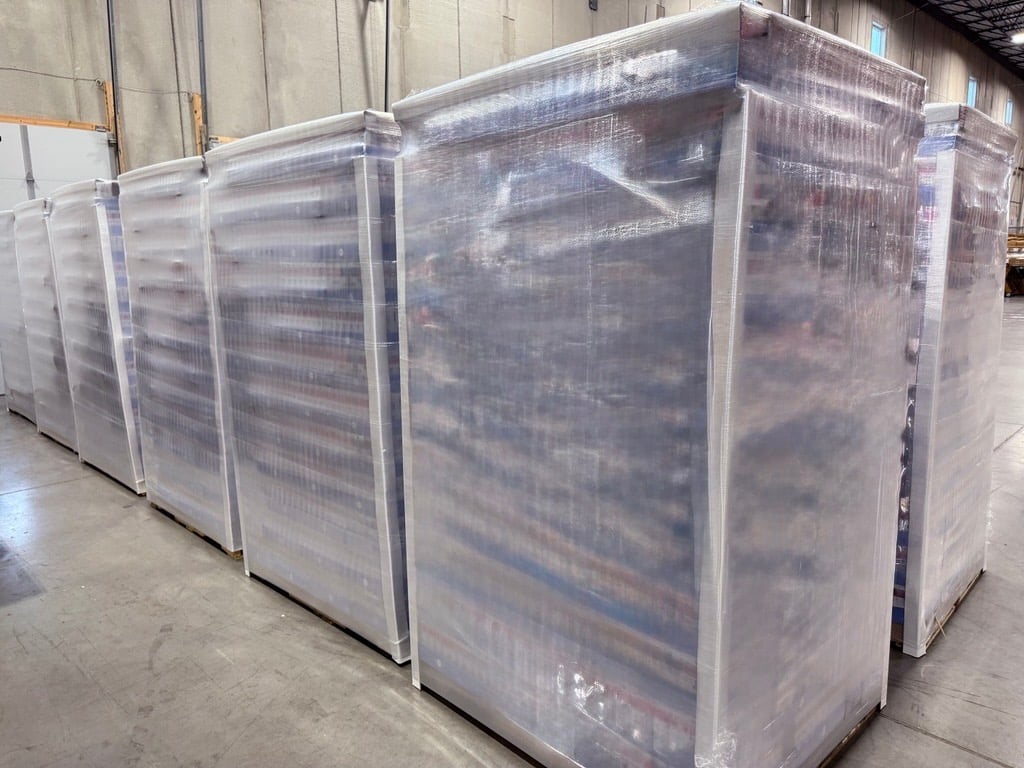
What does Ti-Hi mean on a pallet? Ti-Hi describes how cases stack on a pallet. Ti is the number of cases in one layer, and Hi is the number of layers. Multiply them for the cases on a full pallet: a Ti of 10 and a Hi of 9 is 90 cases. Retailers such as Walmart store your Ti-Hi in their item file and expect every pallet you ship to match it.
Ti-Hi is the stacking pattern for a pallet: Ti is how many cases sit in one layer, and Hi is how many layers you stack. Ti times Hi gives the case count of a full pallet, so a 10 x 9 Ti-Hi means 90 cases. For a brand moving from parcels to retail and B2B orders shipped by the pallet, the Ti-Hi is a number the retailer holds you to. Walmart keeps it in its item file and lists an inaccurate Ti as a pallet-build violation. Parcel orders from ecommerce fulfillment ship one box at a time and don't use a Ti-Hi.
What do Ti and Hi stand for?
Ti comes from tier, the layer of cases that sits flat across the pallet deck. Hi is the high: how many of those tiers you stack. You'll see it written as Ti-Hi, TiHi, Ti/Hi, Ti x Hi or tie-high.
A Ti-Hi always belongs to one case size on one pallet size. Change the carton, or ship on a half pallet, and you need a new Ti-Hi. That's why Walmart's item file holds a Pallet TI and a Pallet HI for every item. For a lighter look at the equipment, our blog has a rhyming tale about a pallet and the forklift that moves it.
How do you calculate Ti-Hi for a pallet?
Work out the Ti first, then the Hi, then check the weight. Here's one case followed from carton to full pallet.
The setup. The case measures 16 x 12 x 10 inches and weighs 18 pounds. It ships on a standard 48 x 40 inch pallet, the footprint Walmart's April 2026 supply chain standards require for a full pallet. Measure your own pallet's height. A stringer pallet built to Walmart's minimum board sizes stands about 4.75 inches, so this example uses 5.
Step 1: find the Ti
Lay the cases flat on the 48 x 40 deck, 10-inch side up, and try the patterns:
- All cases the same way, 16 inches along the 48-inch side. Three fit across (48 inches) and three fit deep (36 inches). That's a Ti of 9, with 4 inches of the 40-inch side left empty.
- Turned the other way, 12 inches along the 48-inch side. Four fit across and two fit deep (32 inches). Ti of 8, with 8 inches empty.
- Mixed orientation. Two rows of three cases with the 16-inch side along the 48 use 24 inches of depth. A third row of four cases turned the other way uses the last 16 inches. Ti of 10, and the layer fills the deck edge to edge.
The mixed pattern wins by one case per layer. Across nine layers that's nine more cases on every pallet, which means fewer pallets and fewer appointments for the same order.
Empty deck space also affects receiving. Walmart's receiving checklist marks cases that underhang the pallet by more than 7.5 inches (3.75 inches per side) as not acceptable for its automated equipment. A gap in the middle of the layer is a separate problem. Walmart bans an unsupported "chimney" gap in the center, because its depalletizers squeeze each layer from all four sides to remove it.
Step 2: find the Hi
Hi comes from the height cap. Subtract the pallet's height from the cap, divide by the case height, and round down.
At Walmart, total pallet height can't exceed 96 inches for general merchandise and dry grocery. So (96 - 5) / 10 = 9.1, which rounds down to a Hi of 9. The loaded pallet stands 95 inches tall.
Step 3: multiply, then check the weight
A Ti-Hi of 10 x 9 is 90 cases. At 18 pounds a case, that's 1,620 pounds of product, plus the pallet. Walmart rates a Grade A stringer pallet for 2,100 pounds loaded, and its receiving checklist marks any single layer over 500 pounds as not acceptable for automation. This layer weighs 180, so the build passes.
Heavier product flips the order of the steps. Once the weight limit bites before the height cap, the Hi comes from the weight.
What changes when a retailer caps pallet height lower?
A lower cap means fewer layers, so fewer cases per pallet. Height caps vary a lot from one retailer to the next, so the same carton earns a different Ti-Hi at each account.
Take the same 16 x 12 x 10 case to Costco. Its July 2026 US routing guide caps dry loads at 54 inches including the pallet, unless the buyer or Costco's traffic team approves an exception in writing. (54 - 5) / 10 = 4.9, so the Hi falls to 4 and the pallet carries 40 cases. That's less than half the Walmart pallet.
Now shave the case to 9.5 inches tall. (54 - 5) / 9.5 = 5.2, so a fifth layer fits, the load stands 52.5 inches, and each Costco pallet carries 50 cases instead of 40. A half inch of carton height is a 25% change in cases per pallet. If you sell to a low-cap retailer, work out the Ti-Hi from your case dimensions before you order cartons.
Other caps from retailer documents:
| Retailer document | Height rule |
|---|---|
| Walmart Supply Chain Standards, April 2026 | 96 inches total, or 85 inches for a full pallet pull that ships to the store unbroken |
| Costco US Shipping & Routing Guide, July 2026 | Dry loads no higher than 54 inches including the pallet |
| francesca's Vendor Compliance Agreement, December 2025 | 84 inches (7 feet) on a 48 x 40 pallet |
| Meijer pallet spec, 2022 edition | Display pallets 60 inches including merchandise. Its automated Witron buildings: 68 inches, not counting the pallet |
Meijer posts its current edition behind its supplier login, VendorNet, so pull the latest copy before you build to it. For its Witron buildings, the 2022 edition asked for at least 2 inches of clearance from the pallet edge on each side. The 10-case pattern above fills the deck edge to edge, so under that edition the Ti would have to drop for those buildings.
How do case packs, inner packs and master cartons fit together?
Ti-Hi counts cases, so the case has to be defined first. Retail packaging nests in levels:
- Selling unit (each). The item the shopper buys, with its UPC.
- Inner pack. A smaller bundle of selling units inside the case. Walmart calls it a warehouse pack, and some DCs ship it to stores on its own as a break pack.
- Case (master carton). The shipping carton the retailer orders by. Its case pack is the number of selling units inside. Walmart calls this the vendor pack and requires a 14-digit case GTIN on vendor pack cases holding more than one selling unit.
- Pallet. Full cases stacked in the Ti-Hi pattern, the unit the DC receives and stores.
Walmart's own example: a vendor pack of 48 holds four warehouse packs of 12. The DC receives the 48-unit case, breaks it, and each store gets an inner pack of 12.
A buyer asking about your case pack wants the units per case. "Master carton" and "shipping case" usually mean the same outer box. When the buyer asks for an inner pack, they're asking for a smaller pack the DC can send to stores whole. Agree on all three numbers before item setup closes, because the retailer's item file, your carton labels and the pallet count are all built from them.
Each pallet carries a GS1-128 label with an SSCC barcode, and Walmart requires that SSCC to match your advance ship notice. That part has its own guide: how GS1-128 carton and pallet labels work.
What gets a pallet rejected at a retail DC?
Most rejected pallets break one of a short list of build rules. These come from Walmart's April 2026 standards unless noted:
- Ti doesn't match the item file. Walmart requires the same case count in every layer, matching the Pallet TI field. Full-pallet orders also need the Hi to match.
- Overhang. No case may hang past the 48 x 40 footprint. Costco's guide bans underhang as well.
- Mixed layers. On a pallet with more than one item, each item fills its layers completely before the next item starts, with a tier sheet between items. Meijer's 2022 spec also bans incomplete layer patterns and layers of uneven height.
- Glued, taped or strapped layers. Walmart bans gluing or taping layers together or to the pallet. Meijer's 2022 spec rules out plastic straps on layers too. Stretch wrap holds the load.
- Bad pallet. A pallet below Walmart's published pallet standards, or one that isn't the standard 48 x 40 size. Walmart lists fees or chargebacks for pallets that miss its pallet standards.
francesca's December 2025 vendor agreement charges 10% of the entire invoice, plus the cost to correct, for improperly built pallets. On a $20,000 order, one sloppy pallet build costs $2,000 before anyone fixes it.
Should you stack cases in columns or interlock them?
Column stacking puts every case directly on top of the case below, corners aligned. It's the strongest pattern for compression, and Walmart requires it for cases with a square footprint. It's also the easiest to knock out of line. Walmart's standards say a misalignment of half an inch in a three-high column cuts stacking strength by as much as 29%.
Interlocking turns each layer the opposite way, so cases bridge the seams below and the load holds together. The cost is compression strength: Walmart puts the loss at 45% to 55%.
Walmart's middle option is the hybrid, often called the 60/40 rule: column-stack the bottom 60% of the pallet and interlock the top 40%. Strength matters because Walmart double-stacks pallets on trucks from its DCs to stores, and a pallet must not be labeled "do not double stack." The bottom layer of a pallet under 750 pounds has to carry another 1,500 pounds. Over 750 pounds, it has to carry 2,500. Pick the pattern your carton can survive, then test it before the first purchase order.
Where KSP builds retail pallets
KSP builds every retail order to that retailer's routing guide and ships it LTL or truckload from 29 dock doors. The advance ship notice is built from what was scanned onto the pallet and reaches the retailer before the truck leaves. The same warehouse has a 50,000 sq ft kitting floor and holds 99.999% order accuracy across 32.1M orders.
Frequently asked questions
How do you work out how many boxes fit on a pallet?
Multiply the Ti by the Hi. Ti is the most cases that fit in one layer without overhang. Hi is the retailer's height cap minus the pallet height, divided by the case height and rounded down. Then check that the total weight stays under the pallet's rated load.
What is the difference between a case pack and an inner pack?
A case pack is the number of selling units in the shipping case the retailer orders by. An inner pack is a smaller bundle of units inside that case, which a DC can send to a store without opening it. Walmart's example is a case of 48 holding four inner packs of 12.
Ship your first retail pallets right
A Ti-Hi that matches the item file, a height under the retailer's cap and layers that hold together on a double-stacked truck are the build rules a retail DC checks when your pallets arrive. Pallet height, wrap and carton labels are set from the retailer's routing guide before the build starts.
Send us your case dimensions, your retail accounts and the purchase order you're preparing. A KSP rep gets back to you within 1 business day and walks you through an invoice built on your products and volumes, line by line.