EDI order processing
Purchase orders arrive through SPS Commerce and drop into the WMS as orders. The advance ship notice goes to the retailer before the truck leaves, and invoices and acknowledgments go back on the retailer's schedule.
Built for brands shipping 500+ orders a month.
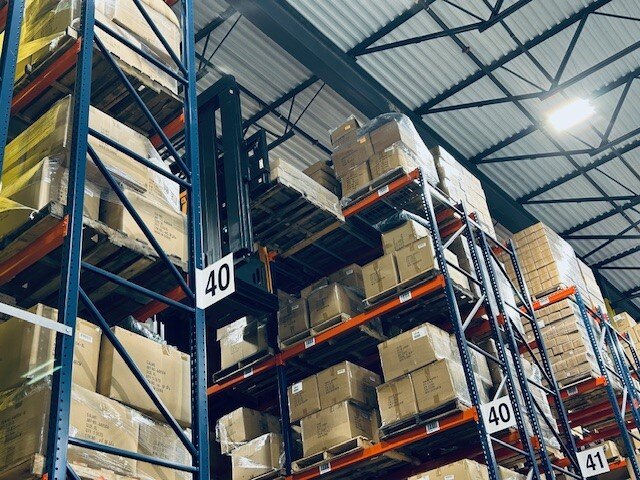
B2B fulfillment is the warehouse work behind orders that go to businesses instead of consumers: retailer distribution centers, individual stores, distributors and wholesale buyers. The order usually arrives as an EDI purchase order and ships in cases or on pallets. Labels, packing and delivery timing have to match the buyer's routing guide, or the retailer charges the miss back to you.
Most growing brands sell both ways. A B2B fulfillment partner should run wholesale and retail orders from the same inventory as your web orders, so you don't split stock between a pallet warehouse and a parcel 3PL. The definition, the allocation math and the questions to ask a 3PL are in omnichannel fulfillment. KSP allocates each retail PO against live stock before it releases to the floor, so the retailer gets its cases and your site keeps selling. Your DTC orders run on the same team's ecommerce fulfillment services.
Every B2B program is set up around your retailers' requirements before the first PO ships.
Purchase orders arrive through SPS Commerce and drop into the WMS as orders. The advance ship notice goes to the retailer before the truck leaves, and invoices and acknowledgments go back on the retailer's schedule.
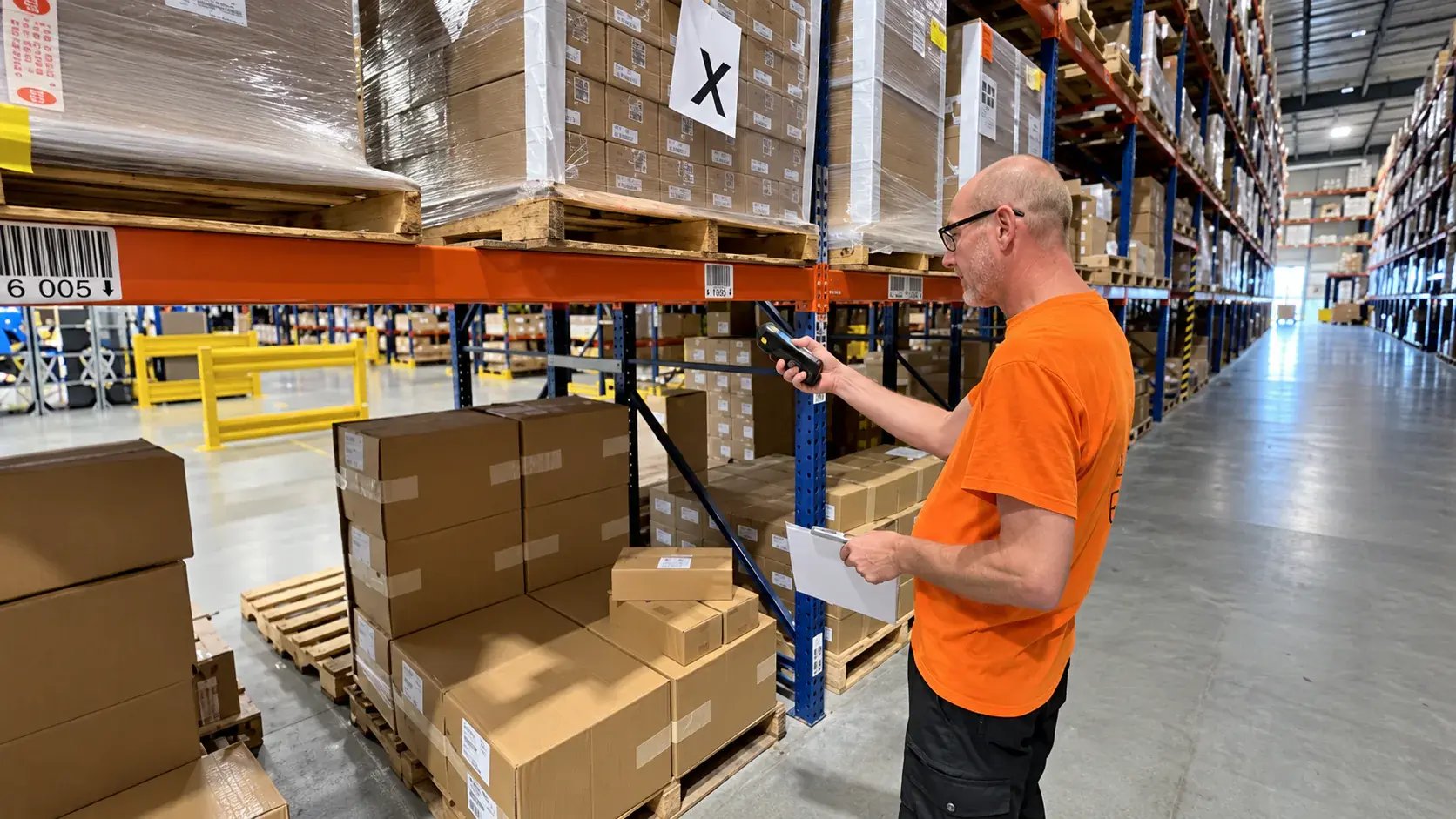
Carton labels, packing lists, pallet height, wrap and placards are set from the retailer's routing guide before the build starts. UCC-128 carton labels are verified before cartons close.
Full cases, inner packs and mixed-SKU pallets come out of the same stock as your DTC parcels. FEFO is the WMS default, so the oldest dated lots ship first.
PDQ trays, floor displays and store-specific kits are assembled on the 50,000 sq ft kitting floor, then palletized for the store.
Pallets leave on LTL or full truckload from 29 dock doors. KSP books delivery appointments and works with the retailer's carrier on routed freight.
Faire orders, distributor POs and drop-ship orders for retailer websites ship from the same inventory, with tracking posted back to the channel.
| B2B order type | What ships, and where | What the buyer checks |
|---|---|---|
| Retail distribution center | Cases or pallets to the retailer's DC, usually LTL or truckload by appointment | UCC-128 carton labels, pallet build and height, an ASN that matches the truck, arrival inside the window |
| Direct-to-store | Store-specific cartons or pallets, one destination per store, often for a launch or reset | Store-level labels and packing lists, delivery before the install or reset date |
| Retailer drop-ship | Single parcels to the retailer's customer, shipped under the retailer's name | Packing slip and label to the retailer's spec, ship confirmation and tracking sent back on time |
| Wholesale and distributor | Cases or mixed pallets to independent stores, distributors or marketplace buyers like Faire. | Correct case packs and counts, the buyer's ship-by date, an invoice that matches the shipment |
Most retail programs mix two or more of these. KSP runs all four from one inventory, next to your DTC orders. For the freight leg of each, see how KSP ships parcel, LTL and truckload.
Five steps from a signed vendor agreement to a compliant first shipment. KSP plans backward from your first ship window.
The routing guide, vendor manual, EDI trading-partner list and your first PO dates.
Each trading partner is connected and its documents are mapped to your SKUs and UPCs.
Labels, case packs, pallet height and wrap, and appointment rules go into the warehouse SOP for that retailer.
Test documents run through the retailer's EDI testing, and the first labels are checked against the guide.
Retail deductions come from a short list of misses: a label that won't scan, a pallet built off spec, an ASN that doesn't match the truck. KSP puts a check at each one.
Verify each case and unit
Every case or unit barcode is scanned against the order. A mismatch stops the workflow until it's corrected.
Check labels against the guide
UCC-128 carton labels are verified before cartons close, and pallets are built to the guide's height, wrap and placard rules.
Send the ASN before the truck leaves
The advance ship notice reaches the retailer before the truck pulls out, built from what was scanned onto the pallet.
Retail programs run in the same building as your DTC orders. Inbound containers and outbound LTL work the same docks, and store kits and displays get built on a dedicated kitting floor.
On time, in full: the retailer scores whether the shipment arrived on the booked date and whether every unit on the PO was there. Walmart fines suppliers 3% of the cost of goods for misses (Supply Chain Brain, reporting the Wall Street Journal).
Walmart's February 2024 revision replaced its single 98% threshold with 90% on time and 95% in full (Logistics Management), and Target sets a 95% fill rate with a 5% of cost-of-goods penalty on unfilled items (SPS Commerce).
APQC puts the cross-industry median for orders delivered complete and on time at 90.0% across 1,781 companies (APQC measure 102357). That is a broad benchmark, not a retailer scorecard. Retailers change these terms without notice, so ask who at a 3PL watches your guides.
Target charges $0.75 per carton when the ASN sent with a shipment is inaccurate, and receiving units with no ASN available exposes a supplier to 3% of the cost of goods (SPS Commerce). Both are document failures rather than damaged goods, so a warehouse working from paper manifests and hand-keyed counts produces them without touching your product. Conexiom's 2024 survey of 898 respondents puts the average cost of a single B2B order error at $17,800 once make-good cost and customer churn are counted, one of the retail benchmarks in our 3PL fulfillment statistics.
A display program had to reach 611 Target stores ahead of a fixed install date. KSP received the inbound freight, built the kits and shipped store-specific pallets to Target's routing guide. No other vendor met the scope 100% or at the speed KSP handled it.
The program moved more than 75,000 cartons across 8 SKUs into 20 kit configurations for 611 Target stores in four weeks, from receiving the product to every outbound pallet built. KSP cross-docked 20 truckloads of more than 800 pallets into our center with the import company, and arranged hot-shot equipment when containers sat in customs so assembly never stood idle.
Compliance got handled at the pallet: an instruction manual in each kit, and 12 custom placards on each of the 611 outbound pallets, three per side at about 80 cartons per pallet, so each delivery reached the right department and team at the store. About 25,000 overage cartons went to the OEM's warehouse for store-level reorders, each labeled with part number, PO and quantity, built under 50 inches to routing requirements across 10 truckloads with appointments managed. All 611 stores received their shipments on time, ahead of the installation schedule, with no damage and no shortages, and without extra warehouse space or rental trailers.
Retail growth breaks fulfillment setups in the same places. If two of these sound familiar, price a B2B program.
KSP runs retail, wholesale and DTC orders from one inventory, with each retailer's routing guide written into the warehouse SOP before the first PO ships.