What is a routing guide? A routing guide is the retailer's rulebook for getting a purchase order from your dock to its distribution center: when the order can ship, which carrier moves it, how cartons are labeled, when the advance ship notice is sent, how pallets are built and how the delivery appointment is booked. Shipments that break it get refused or charged back.
A routing guide is the document a retailer gives its suppliers that spells out how every purchase order must ship: the ship window, who books the carrier, how cartons and pallets are labeled and built, when the advance ship notice (ASN) goes out and how delivery appointments are made. Break a rule and the retailer refuses the freight or deducts the cost from your invoice. Most of what it asks for happens on the warehouse floor, whether you ship from your own building or outsource order fulfillment to a 3PL, so whoever handles your retail and wholesale fulfillment is the one who actually follows it.
Retailers call it different things. Walmart folds much of it into its Supply Chain Packaging Guide, Costco publishes a U.S. Routing Guide, and smaller chains bundle it into a vendor compliance guide or agreement. The sections line up from one retailer to the next, and reading them in the order your warehouse will work them turns a long PDF into a checklist.
Is a vendor routing guide binding?
Yes. A vendor routing guide, vendor manual or compliance agreement is a condition of the purchase order. The December 2025 vendor compliance agreement from francesca's states that accepting one of its POs, or shipping goods to it, binds the vendor to every term in the agreement, and that the retailer can update it at any time by posting a new version to its vendor portal.
Besides the six warehouse sections below, most guides add what goes on the bill of lading (BOL) and a schedule of charges for each kind of miss. Check the date on your copy before the first PO ships, and again before peak.
How do you read a routing guide in the order the warehouse works it?
Start with the section that governs the first decision on the PO and finish with the one that governs the truck at the retailer's door. These six sections hold the rules that touch every shipment. Each section ends with what a miss costs, and our guide to vendor chargebacks and Walmart OTIF fines covers the full fines and how to dispute them.
1. The ship window
Every retail PO carries two dates. The start ship date is the first day the order may leave your dock, and the cancel date is the last. francesca's defines both exactly that way. Some guides add their own margins on top. Scheels' vendor compliance guide (revised August 2016) let product ship up to two days before the "Date to Ship" and required it to leave at least five days before the "Date Cancelled" so it would arrive in time.
Every other clock counts back from this window, so the inventory has to be received, picked and palletized before it opens.
Ship early or late and francesca's charges 10% of the entire invoice.
2. Carrier booking and the routing request
Next, the guide tells you who moves the freight. On collect freight, the retailer pays and picks the carrier. On prepaid freight, you pick the carrier and pay, and you own its on-time arrival.
Collect orders start with a routing request. francesca's wants an EDI 753 routing request submitted five business days before the start ship date, answered with a 754 routing instruction. It caps a truck at 26 pallets and needs a separate routing request for each truck on a multi-truck pickup.
A late routing request costs 5% of the invoice at francesca's, and an unassigned carrier costs 10%.
3. Carton labels
Nearly every big-box guide asks for a GS1-128 label on each carton and pallet, carrying an SSCC-18 serial number that ties that carton to the ASN. Walmart's Supply Chain Packaging Guide (April 2026) requires the SSCC values to match the ASN's carton (MAN) fields, sets a minimum barcode size of 3 inches by 0.75 inches and holds print-and-apply labels to an ANSI grade B or better.
The 2016 Scheels guide adds placement detail you will see in other guides: apply the label crease-free, next to the other shipping labels, and on a non-customer-facing side when the shipping carton is also the retail carton. francesca's requires carton labels generated through EDI, so the label data and the ASN come from the same source.
A missing or unscannable label sends the carton to manual receiving, which Scheels' 2016 guide charged at $25 a carton.
4. The advance ship notice (ASN)
The ASN, EDI 856, tells the distribution center what is on the truck, down to which carton holds which item. It has to match the labels and the load exactly, and it has to arrive before the truck does.
Walmart's packaging guide explains the check. Walmart answers each ASN with a 997 acknowledgment, which only confirms the file arrived. If the data has problems, Walmart sends an 824 application advice listing the errors, and the supplier has to fix and retransmit the ASN before the freight reaches the DC. A clean 997 alone doesn't mean the ASN passed. Scheels' 2016 guide put the timing plainly: the 856 must be transmitted and received before the shipment arrives, and it must match the shipment.
Our post on EDI compliance through SPS Commerce covers how the ASN gets built from what was loaded.
A late, missing or wrong ASN draws a charge even when every unit is on the truck.
5. Pallet spec
Pallet rules vary more between retailers than any other section. Look for pallet type, maximum height including the pallet, wrap, overhang, and whether purchase orders can share a pallet.
francesca's asks for standard 48 by 40-inch pallets no taller than 84 inches, cartons sorted by PO and then by SKU, and a lead pallet carrying the packing list. Wakefern's supplier shipping instructions (August 2024) don't allow two purchase orders on one pallet, and each PO ships on its own bill of lading. The 2016 Scheels guide did allow mixed POs on a pallet when they were going to the same store.
An off-spec pallet gets reworked at the dock or refused, at your cost.
6. Delivery appointment
The last section covers the truck at the retailer's door. Walmart, Costco and Wakefern all receive by appointment, and the appointment record has to match the load. Walmart requires its DC Scheduler appointment to show the SCAC of the carrier actually delivering, every PO on the load and the case count for each PO before the truck arrives. Loads must gate in on time, and a known delay has to be rescheduled before the appointment time, not after.
Wakefern requires appointments for all shipments. Grocery deliveries are appointed when the order is placed, and general merchandise deliveries have to be appointed by the supplier or its carrier.
A truck that misses its appointment can be turned away, and on prepaid freight the late arrival is yours.
Walmart, Target and Costco routing guides compared
Walmart, Target and Costco publish their rules in different ways. Use this as a map to the right document, then work from the retailer's current copy.
| Section | Walmart | Target | Costco |
|---|---|---|---|
| Where the rules live | Supply Chain Packaging Guide (April 2026, public on Walmart's corporate site), plus a Shipping and Routing Guide in Supplier Academy | Compliance policy and routing rules inside Partners Online (POL), Target's vendor portal | U.S. Routing Guide (July 2026) from Costco's traffic department, plus the pallet policy and packaging specifications on its supplier hub |
| Carrier booking | Collect freight follows Walmart's routing instructions, and the BOL carries the Must Arrive By Date (MABD) | Collect freight is booked through Target's ShipIQ or Vendor Ready to Ship workflows, so check which one your PO uses | The PO carrier field reads VENDORS CHOICE for prepaid, the assigned carrier for collect, or CALL TRAFFIC, which means emailing a routing request to Costco's regional traffic team |
| Labels and paperwork | GS1-128 with SSCC-18 on cases and pallets | Barcode and label specs in POL | The BOL lists the Costco PO number, item numbers with sell-unit quantities and actual scale weights |
| ASN | EDI 856, monitored for 824 errors | Measured on whether an error-free ASN is available before the trailer arrives | EDI rules sit outside the routing guide, in Costco's EDI business rules |
| Pallet spec | 96 inches maximum total height for general merchandise and dry grocery, 85 inches for full pallet pulls, layers matched to Walmart's item file | Pallet specs in POL | Quality four-way block pallets, no overhang, dry loads no taller than 54 inches including the pallet unless the buyer or Traffic approves in writing |
| Appointment | Booked in DC Scheduler | Delivered within the PO's ship window | Booked at least two business days ahead, as the correct type (palletized or floor load) |
Target is the one of the three that doesn't publish its full routing guide where non-vendors can read it, so your POL login is the only current source. The Target column follows SPS Commerce's 2025 summaries of Target's compliance program. Costco's July 2026 edition is a good reason to recheck old notes: its dry-load height is 54 inches including the pallet, and anything built to a taller template gets reworked or refused.
Who is responsible for following the routing guide?
The brand is responsible, because the retailer's agreement is with you, and its deductions come off your invoice no matter who built the pallet or booked the truck. The work, though, sits with whoever holds your inventory: label printing, case packs, pallet builds, the ASN and the dock schedule.
That split means the guide has to reach the warehouse before the first PO does, along with any written exceptions your buyer has approved. Freight terms decide who books the truck. On prepaid freight, your 3PL or broker books the carrier and the appointment. On collect freight, the retailer's carrier comes to the dock, and the warehouse's job is to have every carton labeled, every pallet built and the ASN out before the truck arrives.
How does KSP put a routing guide to work?
KSP fills retail and wholesale POs from the same inventory as your DTC orders, and each retailer's routing guide is set up before the first PO ships:
- Setup. You send the routing guide, the vendor manual, the EDI trading-partner list and your first PO dates. Labels, case packs, pallet height and wrap, and appointment rules go into the warehouse SOP for that retailer.
- EDI. POs arrive through SPS Commerce and drop into the warehouse system as orders. Test documents go through the retailer's EDI testing, and the first labels are checked against the guide.
- Labels and pallets. UCC-128 carton labels are verified before cartons close, and pallets are built to the guide's height and wrap rules.
- ASN and freight. The ASN goes to the retailer before the truck leaves. Pallets ship LTL or full truckload from 29 dock doors, and KSP books delivery appointments and works with the retailer's carrier on routed freight.
- Accuracy. 99.999% order accuracy across 32.1M orders, counted on whole orders, and 99.95% shipping accuracy.
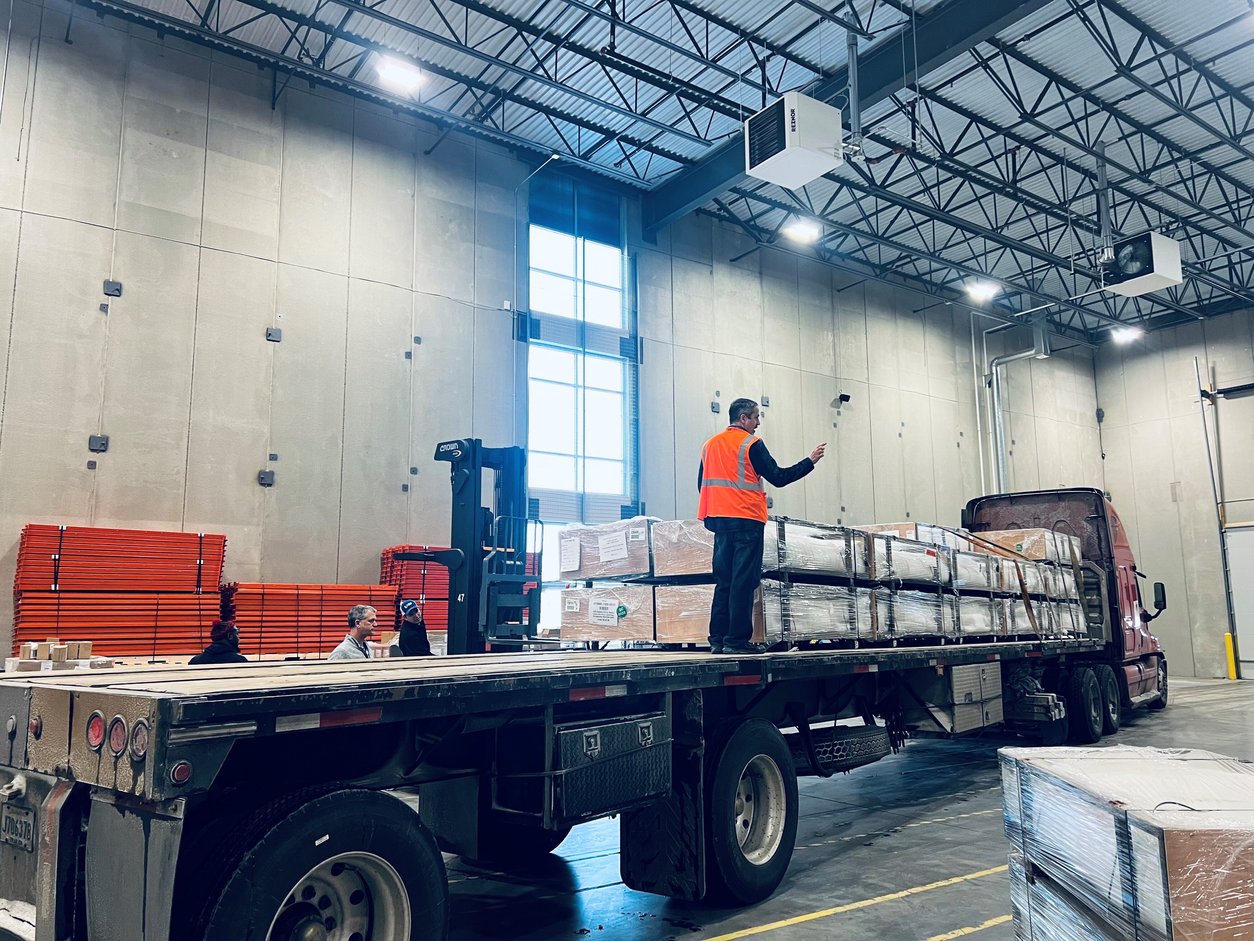
On one Target display program, KSP built and prepared all 611 outbound pallets within four weeks of receiving the product. The overage cartons headed to the OEM's warehouse went out on pallets built to routing requirements and kept under 50 inches, with appointments and schedule changes managed across 10 truckloads. All 611 stores received their shipments on time, ahead of the installation schedule, with no damage or shortages.
Frequently asked questions
What is a routing guide?
A routing guide is a retailer's set of shipping rules for suppliers. It covers the ship window, carrier booking, carton labels, the advance ship notice, pallet specifications and delivery appointments. Retailers refuse or charge back shipments that break it, so the warehouse that ships your purchase orders has to build every order to it.
How do you use a routing guide?
Read it in the order your warehouse ships a purchase order: ship window, carrier booking, carton labels, ASN, pallet build and delivery appointment. Write each retailer's rules into your warehouse's instructions for that account before the first order, and check every new edition for changed heights, deadlines or label specs.
Where do I find Walmart's, Target's or Costco's routing guide?
Walmart publishes its Supply Chain Packaging Guide on its corporate site and keeps its shipping and routing guide in Supplier Academy. Target keeps its routing and compliance policy inside Partners Online, its vendor portal. Costco's U.S. Routing Guide comes from its traffic department, and the pallet policy and packaging specifications sit on its supplier hub.
Get your first retail PO built to the guide
Every section in this guide lands on the warehouse: the ship window, the labels, the ASN, the pallet height, the appointment. KSP writes each retailer's routing guide into the warehouse SOP before your first PO ships, verifies carton labels before they close and sends the ASN before the truck leaves. Your account manager watches the first shipments to each retailer, so a label or pallet problem gets fixed on the first PO instead of showing up as a deduction on the fifth.
Tell us which retailers you just signed and when the first POs ship. A KSP rep gets back to you within 1 business day, walks through how we'd set up each routing guide, and builds an invoice on your business, line by line.