
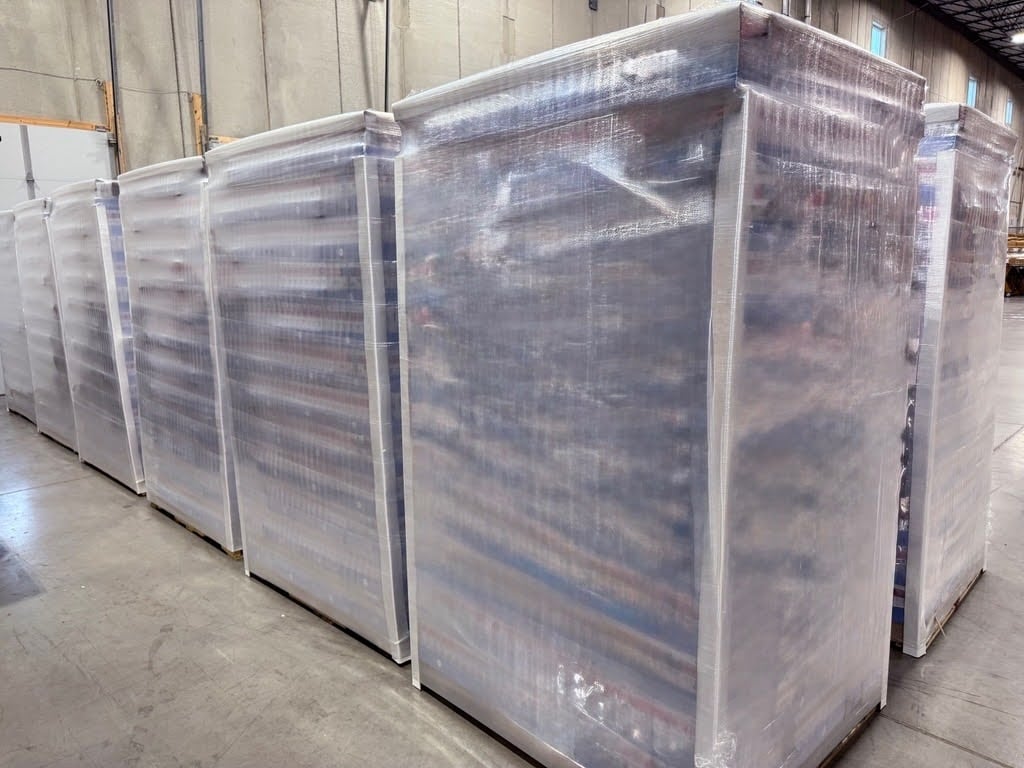
Should my first wholesale order ship LTL or FTL? Ship LTL when the order is one to six pallets and under about 10,000 pounds: you pay for your share of a trailer that also carries other shippers' freight. Book a full truckload (FTL) when you have more pallets or weight, fragile product or a delivery date you can't miss, because the trailer is yours and goes straight to the dock. On collect freight, the retailer picks the carrier for you.
LTL (less-than-truckload) puts your pallets on a trailer shared with other shippers, so you pay for the space your freight takes and it may be unloaded and reloaded on the way. FTL (full truckload) books a whole trailer, usually a 53-foot dry van, for one load that drives straight from your dock to the buyer's. For a first wholesale order, LTL vs FTL is decided by pallet count, weight, how well the product survives handling and how firm the delivery date is. Every one of those facts lives with whoever holds your inventory, whether that's your own building or a 3PL handling your order fulfillment and storage.
What is the difference between LTL and FTL?
Both move palletized freight on the same kind of truck. The difference is whose freight shares the trailer and how often it gets handled.
| LTL (less-than-truckload) | FTL (full truckload) | |
|---|---|---|
| Trailer | Shared with other shippers' freight | Yours alone, usually a 53-foot dry van |
| Shipment size | 1 to 6 pallets, under 12 linear feet of trailer, roughly 100 to 10,000 lb | Any pallet count. A 53-foot trailer holds about 26 to 30 pallets in one layer |
| What you pay for | Your share of the trailer, priced on freight class, distance and handling, plus accessorial charges | The whole trailer, full or not |
| Route | Stops for other freight, and your pallets may be unloaded and reloaded on the way | Loaded once, driven to the delivery dock |
| Delivery date | Often an estimate | Pickup and delivery are more predictable |
| Extra fees | More accessorials (liftgate, appointment, limited access) | Fewer accessorial fees |
Size limits follow the National Motor Freight Traffic Association and Amazon Freight's shipper guidance. Each carrier sets its exact limits in its tariff.
How many pallets is LTL, and when do you need a full truckload?
Start with the pallet count from your case pack and pallet build. Then match it to a mode:
- 1 to 6 pallets, under about 10,000 lb: standard LTL.
- More than 6 pallets: ask for a volume LTL quote. Not every carrier offers it, and the ones that do quote larger LTL shipments on their own terms.
- About 8 to 18 pallets: partial truckload. Your freight still shares a trailer, and it generally arrives sooner than standard LTL.
- A full trailer, or any load where the date matters more than the freight bill: FTL. You can book a full truck for any pallet count.
A worked example: a first PO of 1,200 cases that build 60 cases to a pallet comes to 20 pallets. That's far past any LTL cap and most of a 53-foot trailer, so book the truck. The same retailer's reorder of 300 cases is five pallets and goes LTL.
Weight can override the count. Five pallets at 2,200 pounds each come to 11,000 pounds, past the weight most carriers take as standard LTL, so even a short pallet count can need volume LTL or a truck.
Who books the truck on a wholesale order, you or the retailer?
The freight terms on the PO decide. On prepaid freight, you choose the carrier and the mode, pay the bill and own the on-time arrival. On collect freight, the retailer pays, picks the carrier and often the mode, and your warehouse loads what shows up.
Retailers spell this out in their routing guides. Walmart's Supply Chain Packaging Guide (April 2026) has collect freight follow Walmart's routing instructions. Costco's U.S. Routing Guide (July 2026) puts it on the PO itself: the carrier field reads VENDORS CHOICE for prepaid, names the assigned carrier for collect, or says CALL TRAFFIC, which means sending a routing request to Costco's traffic team. Some guides cap the load as well: francesca's vendor agreement limits a collect truck to 26 pallets and wants a separate routing request for each truck.
Get three answers from the buyer during vendor setup: which freight terms apply, how a shipment gets released for pickup and who books the delivery appointment. Our guide to reading a retailer's routing guide walks each section in the order the warehouse works it.
What does the pickup dock need before the truck arrives?
A loading dock, first of all. Ship from a building without one and the carrier sends a truck with a liftgate to lower or raise the pallets, billed as an accessorial. A storage facility counts as limited access, another charge. A full truckload is loaded at a dock with a forklift.
Then the paperwork and the freight class:
- Freight class from density. On July 19, 2025, the National Motor Freight Classification moved from commodity-based classes to density, measured in pounds per cubic foot, on a 13-step scale. Measure every pallet's real weight and dimensions after it's wrapped. A wrong class on the bill of lading gets re-rated, with fees on top.
- The bill of lading (BOL). Class, weight, pallet count, PO numbers and every accessorial you need, such as liftgate or appointment delivery, go on the BOL.
- Labels, pallet build and the ASN. Pallet height and wrap come from the retailer's routing guide, and pallet height decides how many fit on the trailer: Costco caps dry loads at 54 inches including the pallet. The retailer also expects the EDI 856 advance ship notice to match the labeled cartons on the truck and to arrive before the freight does.
How do delivery appointments work at a retailer's distribution center?
Walmart and Costco distribution centers receive by appointment, and the appointment record has to match what's on the truck. Walmart's DC Scheduler appointment lists the SCAC of the carrier actually delivering, every PO on the load and the case count for each PO. A known delay gets rescheduled before the appointment time. Costco wants appointments booked at least two business days ahead, as the correct type: palletized or floor load.
Mode changes how much control you have over that appointment. A full truckload leaves your dock and drives to the DC, so you can plan the pickup backward from the appointment. LTL freight moves through the carrier's network on the carrier's schedule, and LTL delivery dates are often estimates. Booking a set delivery time with an LTL carrier is its own accessorial, "appointment required."
On prepaid freight, your 3PL or broker books the appointment. On collect freight, the retailer's carrier usually does, and your dock has to release the load in time for the carrier to make it.
When should a first wholesale order go full truckload anyway?
Price FTL next to LTL even on an order under six pallets when any of these is true:
- The product breaks, dents or leaks. Glass, liquids and display-ready cases do better loaded once and unloaded once.
- The delivery window is short, and a missed appointment on a launch order costs more than the difference in freight.
- You're shipping several POs to the same DC in the same week. One truck with one appointment replaces several LTL shipments, each with its own appointment and accessorials.
Ship LTL when the order is a few pallets of sturdy cases, the window has room in it and the DC accepts LTL deliveries by appointment.
How does KSP ship LTL and truckload wholesale orders?
KSP ships retail and wholesale purchase orders LTL or full truckload from 29 dock doors, in the same building that ships your web orders. A big PO is allocated against live stock before it reaches the floor, so it never strands the inventory your website needs.
- Pallet build: carton labels, pallet height, wrap and placards are set from the retailer's routing guide before the build starts, and UCC-128 carton labels are verified before cartons close.
- At the dock: the ASN is built from what was scanned onto the pallet and reaches the retailer before the truck leaves. KSP books delivery appointments and works with the retailer's carrier on routed freight.
- Accuracy: 99.999% order accuracy across 32.1M orders, counted on whole orders, and 99.95% shipping accuracy.
KSP ships to retailers and their distribution centers nationwide, including Target, Walmart, Costco and Chewy. On one Target display program, KSP worked out the stacking and wrapping configuration for LTL transportation and built all 611 outbound pallets within four weeks of receiving the product. The overage cartons for the OEM's warehouse went out on pallets built to routing requirements and kept under 50 inches, with appointments and schedule changes managed across 10 truckloads. All 611 stores received their shipments on time, with no damage or shortages. See how that work fits a full B2B and retail fulfillment program.
Frequently asked questions
What does FTL stand for in trucking?
FTL stands for full truckload: one shipper books an entire trailer, usually a 53-foot dry van, and the load goes from pickup to delivery without other shippers' freight on board. Brands book FTL for orders over six pallets or about 10,000 pounds, fragile product, or a delivery appointment they can't miss.
Why is LTL so expensive?
LTL gets expensive when accessorials pile onto the base rate. The base covers your share of the trailer, priced on freight class, distance and handling. Liftgate, limited access, appointment and residential delivery are each billed on top, and a pallet whose measured density doesn't match its BOL class gets re-rated with fees.
What is the difference between partial truckload and LTL?
Partial truckload covers loads of about 8 to 18 pallets that share a trailer and generally arrive sooner than standard LTL. Standard LTL covers one to six pallets, which may be unloaded and reloaded on the way. Above six pallets, price volume LTL, partial truckload and a full truck side by side before you book.
Get your first wholesale load on the right truck
Your first PO comes with a ship window, a pallet spec, freight terms and a DC appointment, and each of them gets decided on the warehouse floor. KSP builds the pallets to the retailer's routing guide, sends the ASN before the truck leaves and books the delivery appointment or loads the retailer's carrier on routed freight, from 29 dock doors in the building that already ships your web orders.
Tell us which retailer you signed, how many cases the first PO carries and when it ships. A KSP rep gets back to you within 1 business day with how we'd build and ship that load, and an invoice built on your business, line by line.