
What do I need to be retail ready for stores like Walmart? To be retail ready for stores, a brand needs four things in place before the first purchase order: vendor paperwork (W-9, DUNS number and product liability insurance), a GS1 UPC on every unit and case labels that scan, EDI set up for purchase orders, ship notices and invoices, and a warehouse that ships cartons and pallets to the retailer's routing guide on the delivery date. On Amazon, retail ready means listing content, reviews and in-stock inventory instead.
Retail readiness means your brand can accept a store chain's purchase order and deliver it exactly the way the retailer's distribution center expects. For a product brand, that's the B2B fulfillment work behind the order: vendor paperwork, retail-ready packaging and labels, EDI documents, and freight that arrives on its appointment. The retail readiness checklist below has 25 items in those four groups, and each one names what you should have in hand before the first PO arrives.
On Amazon, retail readiness means something else: listing quality, reviews and content. This checklist is about physical stores and the warehouses that supply them, and it covers the supply-chain half that pitch and pricing checklists skip. That half is where first orders lose money, because a shipment that breaks the retailer's rules gets paid short. Our ecommerce fulfillment team ships those retail POs from the same inventory as each brand's web orders.
Start the slow items first. EDI testing with a retailer takes rounds of test documents before live orders flow, and Walmart gives you 30 days after you accept its supplier agreement to upload your certificate of insurance. Labels, case packs and pallet specs come next, because the retailer loads them into its item setup. If a 3PL will ship your retail orders, get its quote on the same lines as the others: the Fulfillment Fee Checklist lists 14 fees to ask every provider about.
Which retail order are you getting ready for?
Retail orders come in four shapes, and the checklist weighs differently for each.
| Order type | How it ships | What the retailer checks | Best for |
|---|---|---|---|
| Retailer DC replenishment | Cases or pallets to the retailer's DC, LTL or truckload by appointment | Carton labels, pallet build and height, an ASN that matches the truck, arrival inside the window | Brands with a chain account that restocks stores from its own DCs |
| Store-direct | Store-specific cartons or pallets, one destination per store | Store-level labels and packing lists, delivery before the install or reset date | Launches, resets and display programs on a fixed date |
| Drop-ship | Single parcels to the retailer's customer, shipped under the retailer's name | Packing slip and label to the retailer's spec, ship confirmation and tracking sent back on time | Brands selling through a retailer's website |
| Wholesale | Cases or mixed pallets to independent stores, distributors or marketplace buyers | Correct case packs and counts, the buyer's ship-by date, an invoice that matches the shipment | Independent stores, distributors and marketplace buyers like Faire |
Three retailer documents come up across this list: the routing guide, the carton and pallet label spec, and the advance ship notice (ASN). Each gets one line here. Our guide to vendor chargebacks explains how retailers enforce all three and what a miss costs.
The items below draw on four public supplier documents: the K-State Extension retail readiness checklist (updated March 2026), Walmart's supplier onboarding checklist, KeHE's supplier policies and procedures (effective November 1, 2025) and Ulta Beauty's vendor standards. Where your retailer's own vendor manual sets a different rule, follow the manual.
Check your retail setup before the first PO
Send us the retailer's routing guide and your first PO dates. A KSP rep gets back to you within 1 business day and shows you which of these 25 items our team covers for you.
Items 1 to 7: Get the product and paperwork through vendor setup
The buyer said yes. Before the vendor setup portal will let you finish, the retailer needs to know who you are, how to pay you and who covers the risk if your product hurts someone.
1. Business registration, EIN and legal name that match everywhere. Walmart's onboarding checklist requires your company legal name to match your W-9 exactly, and it needs a DUNS number to register. Proof you're ready: one legal name, spelled the same on your W-9, state filing, bank account and DUNS record.
2. A W-9 and supplier information forms. KeHE's new supplier document list includes a W-9, a supplier information form with your federal tax ID, and a signed hold harmless agreement. Proof: signed PDFs in a folder you can send the day the buyer asks.
3. Product liability insurance at the retailer's limits. KeHE requires $2 million per occurrence and $2 million aggregate for general and product liability, and $5 million per occurrence for vitamins, herbs, nutritional supplements, seafood and meats. Walmart has you upload a certificate of insurance within 30 days of accepting its supplier agreement. Proof: a certificate naming the retailer as additional insured, at the limits its manual states.
4. A commercial bank account set up for EFT. Most retailers pay vendors by electronic funds transfer, and K-State lists EFT setup next to EDI as business development work to finish before your first wholesale order. Proof: routing and account numbers on company letterhead, ready for the payment setup form.
5. Certifications and standards you can document. Organic, kosher, gluten-free and similar claims need the certificate behind them. Beauty retailers also check how the product was made. Ulta's vendor standards bar products that use animal testing unless the law requires it, and Ulta can require vendors to re-certify compliance every year. Proof: current certificates with expiration dates on a shared calendar.
6. Wholesale cost, MSRP and delivered cost per SKU. K-State's checklist asks for MSRP, regular wholesale cost, F.O.B. cost and delivered cost. Buyers compare your delivered cost against the shelf price to see their margin. Proof: a cost sheet per SKU that already includes freight to the retailer's DC, so you know what a PO earns before you accept it.
7. Order minimums and lead times in writing. Buyers plan purchasing around how small an order you'll take and how long you need to fill it. Proof: a lead time you've tested against your own production and your warehouse's turnaround, written into the vendor setup form.
Items 8 to 14: Get retail-ready packaging and labels that scan at the DC
Retail distribution centers receive by scanning units, cartons and pallets. A carton that won't scan gets pulled for manual handling, and the retailer bills you for the labor.
8. A GS1-licensed UPC on every unit. KeHE requires a scannable 12-digit UPC (GTIN-12) on every unit sold to the retailer. Proof: GS1 company prefix in your name, one UPC per size and variant, and a test scan from a store-grade scanner.
9. Case pack defined for every SKU. The case pack is the number of units in each shipping carton, and it has to match the item setup the retailer loads into its system. Proof: case pack written into your item file and printed on the carton.
10. Case dimensions and weights measured. K-State's checklist asks for gross weight, net weight and case length, width and height. Proof: measured cartons, not the box maker's spec sheet, entered in your item setup.
11. Ti-Hi and pallet configuration set. Ti is the number of cases per layer and Hi is the number of layers. The retailer's routing guide caps pallet height and weight. Proof: a pallet diagram with cases per layer, layers per pallet and total height, checked against the guide's limit.
12. Retail-ready packaging when the buyer asks for it. Retail-ready (shelf-ready) packaging goes from the case straight onto the shelf: trays, PDQs and floor displays. K-State's checklist asks how many units go in each case and how many facings the product gets on the shelf. Building them is kitting work, and a retail display kitting program needs its own pack-out spec. Proof: an approved sample with a written build sheet.
13. Carton labels to the retailer's spec. Ulta requires a GS1-128 label with a serial shipping container code on every carton and pallet, and a label that won't scan is a standard reason for vendor chargebacks. Proof: a printed sample label approved against the retailer's guide.
14. Dated product labeled for rotation. Food, supplements and beauty products with a best-by or expiration date need it on the unit and often on the case. Proof: dates printed in the retailer's format, and a warehouse that ships first-expiring lots first.
Items 15 to 20: Connect EDI and the ASN
Many mid-size and large retailers send purchase orders by EDI, and KeHE requires it for every PO. Our guide to EDI covers the document numbers. These are the pieces to have connected before order one.
15. An EDI provider with your retailer as a trading partner. Proof: the retailer appears as a connected trading partner in your EDI account, with its maps loaded.
16. The 850 purchase order flowing into your warehouse system. A PO that someone retypes by hand is where short shipments start. Proof: a test 850 that lands as an order in the warehouse system with the right SKUs and quantities.
17. The 855 acknowledgment going back on the retailer's clock. KeHE requires the 855 order acknowledgment. Proof: a test 855 sent and accepted, plus the deadline written in your SOP.
18. The 856 advance ship notice built from what was actually packed. The ASN tells the DC what's on the truck before it arrives, and it has to match the carton labels. Proof: a test ASN generated from scanned cartons, not typed from the PO.
19. The 810 invoice matching the shipment. An invoice that bills for units the DC didn't receive gets paid short. Proof: a test 810 built from the same shipment data as the ASN.
20. EDI testing signed off by the retailer. Retailers run test documents before they send live orders. Proof: written approval from the retailer's EDI team that your test cycle passed.
Items 21 to 25: Get shipping to the DC on time
The last five items decide whether a correctly packed order reaches the DC inside its delivery window, which is what retailers score as on-time, in-full.
21. The routing guide read and turned into a warehouse SOP. The routing guide sets carrier choice, pallet build, labels and appointment rules. Proof: one SOP page per retailer that the pick team uses, with pallet height, wrap and label placement on it.
22. Freight terms understood: prepaid or collect. Some POs ship on the retailer's carrier and some on yours. Proof: you know who books the truck for each PO before it's picked.
23. Delivery appointment process set up. DCs receive by appointment, and a truck that arrives a day early can count as a miss. Proof: login to the retailer's appointment portal and a named person who books and confirms each one.
24. Enough production capacity to fill the first reorder. K-State lists reliable production capacity as a wholesale requirement, because retailers need to know you can keep the shelves stocked. Proof: inventory on hand or in production to cover the first PO plus at least one reorder.
25. A warehouse that ships retail POs and DTC orders from one inventory. A brand that splits stock between a pallet warehouse and a parcel 3PL has to forecast two piles. Proof: one stock count, with each retail PO allocated against live inventory before it goes to the floor.
What does retail readiness look like at full scale?
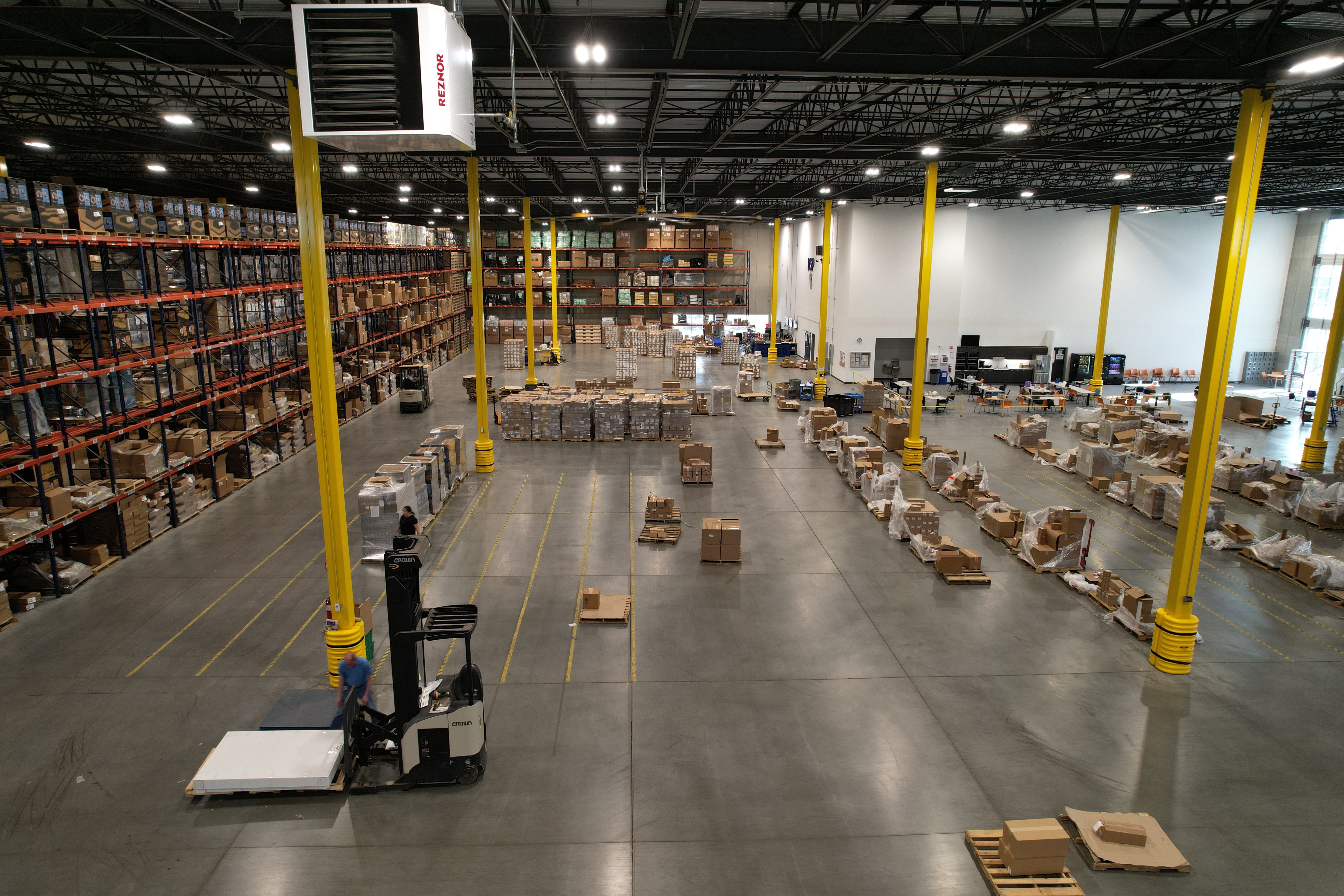
A rollout to 611 Target stores put most of this list to work at once: more than 75,000 cartons, eight SKUs and twenty kit configurations, assembled on our 50,000 sq ft kitting and assembly floor. Within four weeks of receiving the product, we had built and prepared all 611 outbound pallets, averaging about 80 cartons each. Each pallet carried 12 custom placards, three on each side, so it reached the correct department and team at each store. About 25,000 overage cartons went to the OEM's warehouse, each labeled with its part number, PO and quantity, on pallets built to routing requirements and kept under 50 inches. All 611 stores received their shipments on time, ahead of the installation schedule, with no damage or shortages.
The same building ships your DTC orders, at 99.999% order accuracy across 32.1 million orders. Retail POs arrive through SPS Commerce, UCC-128 carton labels are verified before cartons close, and the ASN goes to the retailer before the truck leaves. Pallets ship LTL or full truckload from 29 dock doors, and we book the delivery appointments.
Get your first PO built to the retailer's rules
Labels, EDI, pallet builds and appointments on this list all happen inside a warehouse. If your current 3PL ships parcels well but has never built a pallet to a routing guide, the first sign of trouble is a short payment on your first retail invoice.
KSP connects your retailer through SPS Commerce, sets labels, case packs and pallet rules into the warehouse SOP before the build starts, and ships the PO from the same inventory as your web orders. Send us the retailer, the routing guide and your PO dates. A KSP rep gets back to you within 1 business day and walks you through an invoice built on your products and volumes, line by line.