Omnichannel fulfillment means every channel your brand sells through, your own store, Amazon, a distributor, a retailer's purchase order, sells out of one inventory count. The same 40 units of your hero SKU sit in one location, and any order can take one of them: a Shopify customer at 9 a.m., an Amazon order at noon, a Target PO being picked for Friday's trailer. Nobody reserves stock for a channel in advance. Under multichannel fulfillment you would carve that stock into per-channel buckets, and the Amazon bucket would run empty while the Shopify units sat on a shelf. KSP ships direct-to-consumer (DTC) parcels and retail pallets from one 225,000 sq ft building in Brooklyn Park, Minnesota against one count, through B2B fulfillment services for retail and wholesale orders and ecommerce fulfillment services that share the same floor and the same team.
What omnichannel fulfillment means on a warehouse floor
Every guide gives the same software answer: one available-to-promise number that updates as orders arrive from each channel. On a warehouse floor it comes down to three jobs done right.
One inventory figure per SKU. Your WMS holds a single on-hand number. Channel rules decide what each channel can see and sell, but the physical stock is shared. When 40 units go out to a retailer in the morning, a Shopify order placed at 10:14 sees 40 fewer units available that same day.
Channel rules applied at the pick line. A DTC parcel needs a poly mailer, an insert and a tracking number. A Target PO needs carton labels, a 124- or 125-number, a pallet built to the routing guide and an advance shipping notice (ASN) fired when the trailer leaves. One team picks both and the packing step splits them. Get that wrong and you get one of two failures: retail orders packed like parcels and hit with chargebacks, or parcels handled like pallet work and shipped late.
Returns come back into the pool. A returned unit gets inspected, graded and either restocked to the shared count or quarantined. A return that re-enters only the channel it shipped from strands a sellable unit in the wrong silo.
Omnichannel vs multichannel: where your inventory actually goes
Say you have 1,500 units of your hero SKU and three channels. The split model reserves 500 for Amazon, 500 for your store and 500 for wholesale. Amazon moves fast, the Amazon bucket sells out in week two, and your retail buyer's PO gets shorted or your DTC ads stay paused for a month because the store bucket is committed. Those units are not sold. They are stuck, and cash is sitting in a bucket nobody is drawing from.
One pool sells all 1,500. The trade is that nothing is reserved, so a surprise order on one channel can take stock another channel was counting on. You manage that with demand signals and receiving cadence, which is the cheaper problem.
| Per-channel buckets | One shared pool | |
|---|---|---|
| Inventory count | Per channel, reconciled on a schedule | One available-to-promise figure |
| Oversells | Two channels sell the last unit inside the sync window | Count updates as orders land, second buyer sees zero |
| Stock-out pattern | A bucket empties while siblings sit | The whole SKU runs down at its real rate |
| Retail PO + parcel | Two providers, or two floors | Same pick path, different pack-out |
| Returns | Back to the originating bucket | Graded, then back into the shared count |
| Reporting | One dashboard per channel, stitched by hand | One source of truth per order and per SKU |
| What breaks | Stranded stock and manual cancels | Routing rules misconfigured |
Plenty of providers describe themselves as omnichannel and run per-channel stock with a dashboard on top. The question that separates them: what happens to a unit that comes back through your DTC channel? Under a shared count it gets inspected, graded and put back where every channel can sell it. Under a bucket model it goes back to the channel that shipped it.
What has to be true for one inventory pool to work
Integration depth, live. The pool only stays honest if every channel talks to the same system on the same clock. KSP connects 100+ selling channels, carriers and trading partners, with 45 pre-built integrations covering Shopify, WooCommerce, BigCommerce, Magento, Amazon, Walmart and NetSuite, plus open API. Adding a channel should be a mapping exercise, not a new warehouse process.
EDI and routing compliance in the same building. Retail orders complicate things because they require a lot more specific paperwork. A retailer's purchase order arrives through electronic data interchange (EDI) as an 850, the shipment notice that travels with it is an 856, and the invoice is an 810. Each retailer adds its own labeling, pallet-height and appointment rules. KSP runs EDI through its SPS Commerce partnership for Target, Walmart, Costco and Amazon requirements, with 29 dock doors for pallet freight and truckload. Your on-time in-full (OTIF) score and your chargeback totals depend on the stock and the documents moving together.
Capacity to run parcel and pallet work side by side. 60 Locus robots bringing inventory to pickers, a 50,000 sq ft kitting floor, and orders received by 2 PM CST shipping the same day. Pick and pack runs in under 30 minutes on the DTC side, and the 99.999% figure is order accuracy, measured on the complete order rather than the pick alone.
One reporting view. Cost per order, inventory turns, fill rate and returns by SKU, in one place. Split-channel reporting tells you at quarter close, after the damage.
Someone who can walk to the problem. Account managers sit in the building, thirty feet from the floor. A retail rejection or an oversell gets resolved on the floor, not through a ticket queue. KSP's published resolution benchmark is 10 minutes on a live issue.
The Amazon wrinkle: FBA is a second count
Amazon is the exception, because inventory inside Fulfillment by Amazon (FBA) sits in Amazon's buildings under Amazon's count. Here are two ways to handle it, and which one fits depends on how much of your volume lives on Amazon:
- Keep FBA in the model. Then the honest setup is one pool plus an FBA replenishment plan: your 3PL holds the master count and sends FBA inbound in batches, so the FBA quantity is a transfer out of the shared pool rather than a second pool you reconcile monthly. Amazon ended its in-house FBA prep service in January 2026, so prep and labelling now sit with whoever holds your stock, and that work belongs on the same floor as your pool. KSP builds FBA bundles and prep on its kitting floor.
- Run Fulfilled by Merchant or Multi-Channel Fulfillment from your pool. Amazon orders ship from your 3PL against the shared count, which keeps one number and puts the shipping SLA on your provider. That fits a catalog too small to split.
What doesn't work is treating the two counts as one. An oversell almost always traces back to the same gap. The spreadsheet says 900 units exist, and the floor says 740.
Where a per-channel split leaks money
A per-channel split costs you in four places, and none of them appear as a labeled line on an invoice.
Safety stock you didn't choose. A brand that can't trust one count pads every channel. Five percent padding on a $40 cost-of-goods SKU across four channels is cash you financed and warehoused for nothing.
Manual cancels and their downstream damage. An oversell becomes a cancellation, a cancellation becomes an Amazon A-to-z claim or a late-shipment defect, and the refund lands in a returns queue.
Stranded allocations. Stock committed to a channel that stopped selling it ages, gets written down, or moves at cost.
Two providers, two invoices, one reconciliation. A parcel 3PL plus a pallet warehouse means duplicate receiving, duplicate counts, a transfer process you manage by email, and nobody accountable for the number that matters. The reconciliation labor is a headcount line.
One pool, two shapes: a parcel and a pallet
Ask to see a retail program and a DTC program running at the same time. KSP built a display launch for 611 Target stores on a fixed install date: 20 truckloads and more than 800 pallets cross-docked and transported in, eight SKUs kept on hand so assembly never stalled, and all 611 outbound pallets built within four weeks, averaging about 80 cartons each with 12 custom placards per pallet so each store's department got the right kit. Roughly 25,000 overage cartons went to the OEM's warehouse in 10 truckloads on pallets under 50 inches, labeled with part number, PO and quantity to support store-level reorders. All 611 stores received on time, ahead of the install schedule, with 100% accuracy, no damage and no shortages, and no extra warehouse space or leased trailers.
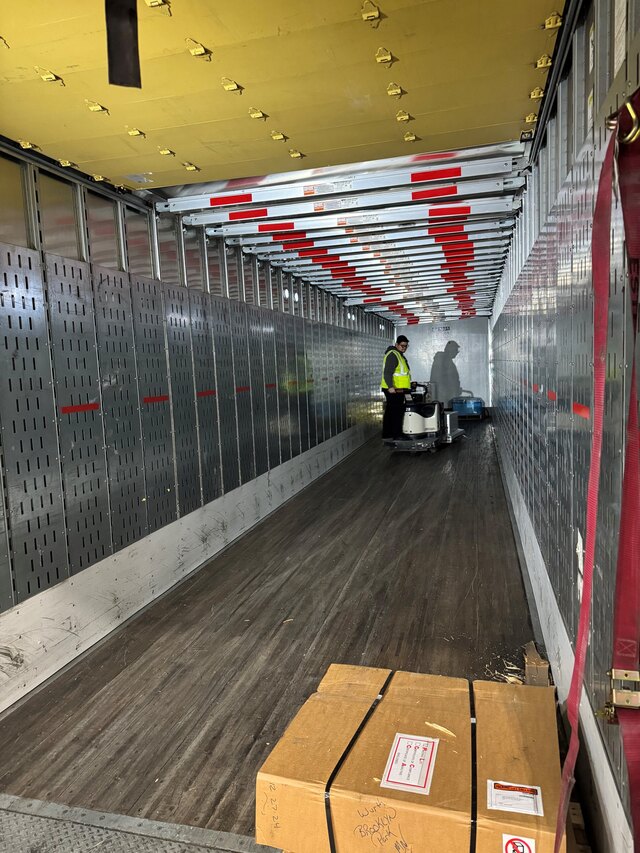
That project didn't pause the parcel side. The same building, the same count and the same team shipped daily DTC orders through those four weeks. A shared count is what lets a retail rollout run without a second operation, and it keeps reorder buffer stock sellable instead of parked in a separate pile.
What to ask a 3PL before you accept "omnichannel"
Brands look for this capability when they've outgrown the pattern of one provider for DTC and another for everything else. The story shows up the same way in founder accounts: one 3PL handled direct orders well and had no idea how to prep for Amazon or ship to a big-box retailer, the next wanted wholesale only and couldn't handle direct-order details like gift notes or VIP bundles. A brand running both sides ends up reconciling two inventory counts and two sets of rules by hand, and each provider blames the other's data. These eight questions sort the providers that run one count from the ones that juggle two.
Ask each on the call. The wording matters more than the confidence.
- "What is my available-to-promise number, and how fast does it move?" A provider running one count names the sync cadence. "Real-time" with no number behind it means a scheduled sync, and a scheduled sync is where oversells live.
- "Show me a retailer PO and a DTC order for the same SKU." You want to see one pick path and two pack-out paths. If the answer requires two floors or two providers, you're looking at a bucket model.
- "Who owns the EDI maps and the routing guides, and who pays a chargeback?" You want named responsibility on both sides, and their OTIF and chargeback history on accounts shaped like yours. One founder publicly put his retail chargeback damage at roughly a quarter of a million dollars a year with a large-name provider, then under $15,000 a year after switching. Another said a well-known 3PL wouldn't ship his retail orders at all and nearly cost him a seven-figure annual account.
- "How does a return re-enter stock?" Graded, then into the shared count. If it re-enters only its originating channel, your returned units are stranded.
- "Where do FBA or marketplace-warehouse quantities sit in your count?" They should transfer out of your count. A parallel quantity you reconcile by hand is a bucket model with extra steps.
- "One invoice, one report?" Per-channel dashboards stitched by hand means you own the reconciliation.
- "Who is on the floor when it breaks, and how fast?" Ask for a named person and a response benchmark you can hold them to.
- "What do you not do?" KSP runs one building in Minnesota, so if you need buy-online-pickup-in-store or ship-from-store, or in-market warehouses in Canada, the UK or the EU, you need a network. KSP ships internationally to 220+ countries from the US and reaches any US address by ground in 1-3 days. Not to mention we do have a couple Canada-based brands that ship out of our warehouse.
When multichannel is the right call
Keep separate buckets when your channels genuinely sell different catalogs. Keep them while your volume is low enough that manual reconciliation costs less than integration work. And keep an FBA-only strategy on Amazon when the Prime badge matters more to you than one count. A 3PL can still build your FBA inbound and handle the rest.
Where the math flips is a shared catalog plus retail. If a buyer's PO and a Shopify order can want the same unit this week, one count ends the guessing. At KSP that profile looks like 500+ orders a month across a focused catalog, under about 250 live SKUs, with monthly orders divided by live SKUs at 3 or more. The operations that make one count pay, one receiving team, one count, robots that reward pick density, a kitting floor building retail kits between parcel waves, are the ones a brand needs at that volume already.