
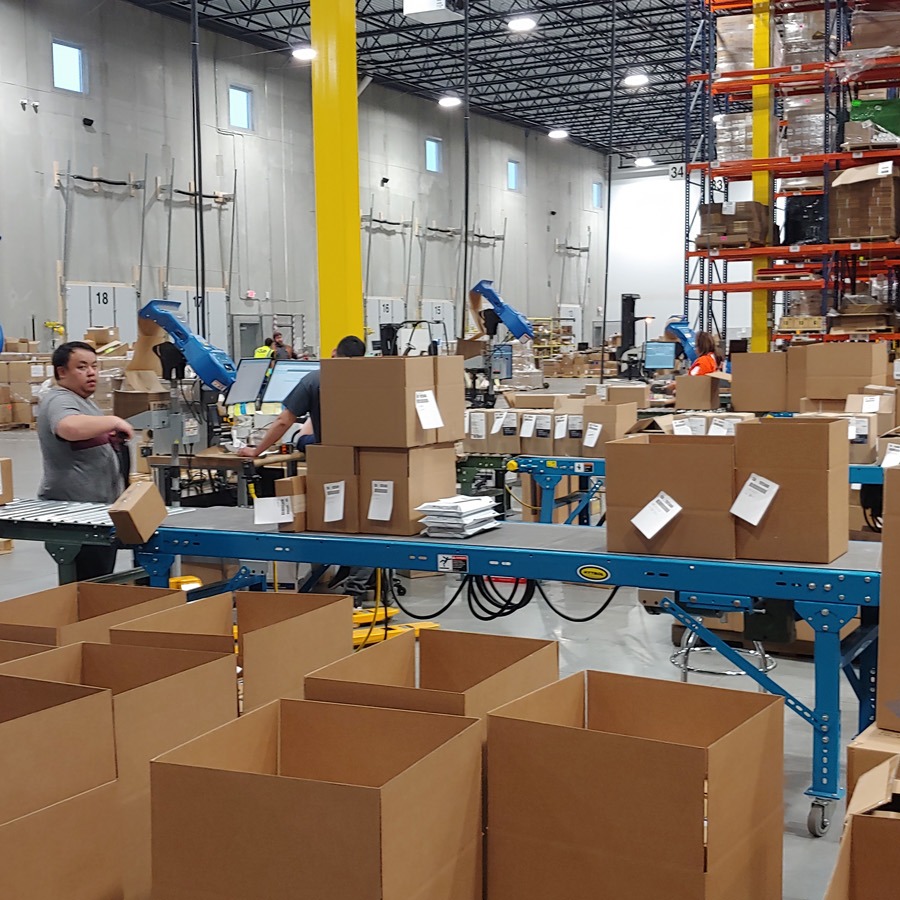
What is warehouse inventory management? Warehouse inventory management is the work of receiving, storing, counting and shipping stock so the system count matches what is on the shelf. It covers receiving against the shipping notice, putaway to tracked locations, cycle counts, lot and serial capture, picking, returns and the stock reports a brand sees.
Warehouse inventory management is how a warehouse keeps its system count equal to the units on the shelf, from the moment a truck is unloaded to the moment an order ships. For a brand using a 3PL, it decides whether the stock your store shows is stock you can actually ship. At KSP, inventory sits in one pool for ecommerce, marketplace and retail fulfillment, and the count feeds every channel through store and marketplace integrations to the Logiwa WMS. This guide follows your units from the dock to the shelf to the order, and shows how to check the count yourself.
What is warehouse inventory management?
It covers every step where a unit gets scanned, moved or counted, because each of those steps either keeps the system and the shelf in agreement or lets them drift apart:
- Receiving. Inbound cartons and pallets are counted and scanned against the advance ship notice (ASN) you sent.
- Putaway and locations. Each SKU goes to a bin, shelf or pallet position with its own barcode, and the WMS records how many units sit there.
- Counting. Cycle counts check a few locations every day, so errors get caught and fixed without shutting the building for a full physical inventory.
- Lot and serial capture. Lot numbers, expiration dates and serial numbers get recorded where the product needs them.
- Picking. Every unit is scanned out of a specific location against a specific order, so the system knows which shelf lost a unit.
- Returns. Returned units are inspected and graded. Sellable ones go back to available stock, and the rest are set aside.
- Reporting. On-hand, allocated and available counts by SKU, visible to you without emailing anyone.
The WMS records each scan, and a team checks the records against the shelves. KSP's inventory control team spends its day on cycle counting, inventory tracking, verifying variances on inbound and outbound shipments, and SKU swaps a client asks for.
What happens when your inventory arrives at the dock?
A count that goes wrong at receiving stays wrong until someone recounts the location. If 480 units arrive and the system records 500, every number after that is wrong, and you find out when an order for the last 20 can't be filled.
At KSP, inbound cartons are counted and scanned against your ASN before any stock becomes available to sell. Each inbound SKU is checked against its item and barcode mapping at the dock, and every pallet gets a license plate number (LPN) at check-in, a barcode that carries the pallet's SKU, quantity and lot. A short shipment, an overage or a mislabeled carton gets reported to you that day, before it becomes an oversell.
Then putaway. Each SKU goes to a tracked location, and receipts add to your available stock only once they're counted and put away, not when the truck is booked. Your store never sells units that are still sitting on a trailer.
The truck itself runs through a schedule. In our building, dock appointments run on Dock Control from our sister brand KSP Technologies, which tracks each inbound load from Scheduled to Arrived, Received, Putaway and Completed, with trailer, seal and documents captured at the gate. It sits beside the WMS and handles the dock work. The WMS keeps the count.
Receiving moves faster when the ASN matches the freight. Send SKU, quantity and lot per carton, and label cartons with the same barcodes your SKUs carry in the WMS, so receiving scans each carton instead of opening it to identify the product. A receiving error found weeks later means tracing which orders drew on the bad count. One premium linen brand came to KSP after its previous 3PL's receiving errors left inventory unsellable for weeks heading into peak season.
How does a 3PL keep inventory counts accurate?
A 3PL keeps counts accurate by scanning every move and recounting a little every day. The scans keep errors from entering the system, and the counts catch the ones that got in anyway.
Cycle counting
A cycle count is a scheduled count of a small set of locations, done while the warehouse keeps shipping. Over weeks, every location gets counted, and the busiest ones get counted most. Warehouses usually pick what to count in four ways:
- By velocity. Fast movers get counted most often, because they're touched most and drift fastest. This is called ABC counting.
- By trigger. A location gets counted the moment something looks off: a pick comes up short, a bin shows empty when the system says it holds stock, or a return lands in a location with a variance.
- At low stock. Counting a location when it's nearly empty takes seconds and confirms the count before the next receipt refills it.
- Blind. The counter doesn't see the expected quantity, so the count records what is on the shelf instead of confirming a number.
When a count finds a variance, a second person recounts before anyone adjusts the system. Then someone works out where the units went: a pick from the wrong bin, a mis-scanned receipt, a return put away in the wrong spot. Adjusting the number without finding the cause means the same error shows up next month. That investigation is the variance verification KSP's inventory control team runs on inbound and outbound shipments.
Scan checks at the pick
Every unit is scanned when it leaves a location. At KSP the tote is scanned so a pick is tied to one order, then each unit's barcode is checked against the order, and a wrong item doesn't register. Those scans keep the shelf count right as well as the order: if an associate picks a unit from the wrong bin, the scan catches it before two location counts go bad. More than 135 Locus robots carry the totes through picking, so associates spend their time picking and scanning instead of walking.
Lots, expiration dates and serial numbers
For supplements, cosmetics, gummies and packaged food, the count has to be right per lot, not just per SKU. Lots and expiry dates are recorded at receiving, and FEFO (first-expired, first-out) is the WMS default at KSP, so the oldest dated lots ship first. Serial numbers are captured on inbound and outbound where the product needs them. All of it sits in climate-controlled, FDA-registered storage, so the units the count says are sellable are still in spec when they ship.
How do you calculate inventory accuracy?
Calculate inventory accuracy per location: count a set of SKU locations, then divide the locations where the shelf matches the system by the locations counted. Some KPI guides divide the total system count by the total physical count instead. That ratio hides errors, because a shortage on one SKU and an overage on another cancel out.
Say a cycle count covers these five locations:
| Location | SKU | System count | Shelf count | Match |
|---|---|---|---|---|
| A-01 | Lavender soap | 200 | 200 | Yes |
| A-02 | Mint soap | 150 | 138 | No, 12 short |
| B-01 | Citrus soap | 80 | 92 | No, 12 over |
| B-02 | Rose soap | 60 | 60 | Yes |
| C-01 | Unscented soap | 310 | 310 | Yes |
The system holds 800 units and the shelves hold 800 units, so the total-count formula reports no error at all. Two of the five locations are wrong. The location match rate is 3 of 5, or 60%. The store will oversell mint soap by 12 units and hold back 12 citrus units it could have sold.
Track size as well as frequency. Add up the absolute variance (12 short plus 12 over is 24 units) and divide by the system count: 24 ÷ 800 is a 3% unit variance. The match rate tells you how often the count is wrong, and the unit variance tells you how far off it is when it is.
Inventory accuracy and order accuracy measure different things. Inventory accuracy checks the shelf against the system. Order accuracy checks what the customer received against what they bought, and it's covered in our guide to how 3PL order accuracy is measured. The two connect, because an order picked from a bad count ships short or waits. KSP runs at 99.999% order accuracy across 32.1M orders and 99.95% shipping accuracy.
What should you see from your 3PL?
You should be able to answer "how many do we have?" without emailing anyone. At KSP, clients see real-time stock by SKU in a client portal, along with orders and shipment status. Ask any 3PL to show you these in a live account:
- Stock by SKU. On-hand, allocated to open orders, and available to sell, from one pool that every channel draws on.
- Stock by lot. Units per lot with expiration dates, if your product carries them.
- Receiving reports. Each inbound shipment against its ASN, with shortages, overages and damaged cartons listed.
- Cycle count results. Locations counted, variances found and the adjustments made, by SKU.
- Returns. Every returned unit, its condition grade and whether it went back to stock.
- Retail allocations. Units held for a wholesale or retail PO. At KSP, a large PO is allocated against live stock before it releases, so it doesn't strand units your website needs.
If a 3PL can show you on-hand but not the adjustments behind it, you can't tell a clean count from a corrected one.
What should you ask a 3PL about inventory control?
Ask these before you sign, and get the answers in writing:
- When does received stock become sellable? It should be when it's counted and put away against your ASN.
- How are receiving discrepancies reported? Ask for the format and how fast you get it after the truck is unloaded.
- How often do you cycle count, and which SKUs come first? Fast movers and problem locations should be counted most.
- How do you calculate inventory accuracy? Ask for the location match rate, not total units against total units.
- What happens when a count finds a variance? Expect a recount, a cause and an adjustment you can see in a report.
- Do you track lots, expiration dates and serial numbers? Ask how each is scanned at receiving and at the pick, and which lot ships first.
- How do returns get back into stock? Ask who grades them and how fast sellable units become available again.
- Who owns a count problem? At KSP, it's one account manager on the floor, with a 2-hour response SLA when something goes wrong.
If your units ship from more than one place today, or your counts drift every month, move them to a 3PL that runs receiving, storage and shipping from one inventory. At KSP, orders received by 2 PM CST ship the same day from the same stock the portal shows you.
Frequently asked questions
What is inventory accuracy?
Inventory accuracy is how closely a warehouse's system count matches the units on the shelf. Measure it per location: divide the SKU locations where the count matches by the locations counted. Total units against total units hides errors, because an overage on one SKU cancels a shortage on another.
How often should a warehouse cycle count?
Count fast-moving SKUs most often and slow movers least, so every location gets counted over the cycle. Add trigger counts whenever a pick comes up short or a bin looks wrong, and count locations at low stock, when the count takes seconds. Ask your 3PL for its schedule in writing.
What is the difference between inventory management and warehouse management?
Inventory management decides how much stock you hold, where it sells and when to reorder. Warehouse management runs the building: receiving, locations, picking, packing and shipping. Warehouse inventory management is where they meet, keeping the count in the warehouse right so your inventory plans start from true numbers.
See your inventory the way we'd run it
Tell us your SKU count, channels and monthly orders, and we'll walk you through receiving, counts and pricing line by line.